Tahlia Pollock @bristolpalaeo.bsky.social has an amazing new study integrating 3D shape, biomechanics, and optimality modelling, helps explain why so many mammals evolve sabre teeth: functional optimality was a key driver behind the repeated evolution of extreme sabre-tooth morphologies.
11.01.2025 11:08
👍 18
🔁 5
💬 1
📌 0
Fascinating…
11.01.2025 14:24
👍 1
🔁 0
💬 0
📌 0
Looking for reviewers before Christmas
11.12.2024 05:25
👍 676
🔁 89
💬 11
📌 23

Analyzing the Life History of Caimans: The Growth Dynamics of Caiman latirostris From an Osteohistological Approach
This research offers insights into the life history and growth dynamics of Caiman latirostris, highlighting their growth patterns, aging, and attainment of sexual maturity, and how environmental cond...
Eugenia, P.M., Bona, P., Siroski, P. and Chinsamy, A. (2025), Analyzing the Life History of Caimans: The Growth Dynamics of Caiman latirostris From an Osteohistological Approach. Journal of Morphology, 286: e70010. doi.org/10.1002/jmor...
20.12.2024 15:04
👍 16
🔁 7
💬 1
📌 0
I’ve had some really amazing discussions about this position with a bunch of people… makes me wish we could hire them all!! Seriously, there are some amazing young scientists out there…
20.12.2024 22:58
👍 0
🔁 0
💬 0
📌 0
Spent the afternoon helping my students prepare for a big day tomorrow. The first day of sampling for our AHA-funded project starts at 7:30am tomorrow!!!
20.12.2024 22:57
👍 0
🔁 0
💬 0
📌 0

Illustration of the extinct walrus Valenictus swimming through an early kelp forest; the seafloor consists of rocky outcroppings covered in giant green anemones, mussels, urchins, sea stars, with a few other friends (spider crab, wolf eel, abalone, rockfish, a couple of garibaldi fish, and a California sheepshead). Several giant and bull kelp stalks are present.

The skull of Valenictus sheperdi; the skull is facing to the right in oblique view, and the tusks are missing.
#artadventcalendar x #fossilfriday Valenictus sheperdi, an extinct tusked (but otherwise toothless) walrus from the Pliocene Purisima Formation of northern California - here shown cruising along an early rocky shore habitat. We named this earlier this year. 🐡🐬🦑🦖
20.12.2024 18:09
👍 73
🔁 15
💬 2
📌 0
OMG! I have all of these tucked away somewhere too!
20.12.2024 22:52
👍 1
🔁 0
💬 0
📌 0

3D visualisation of Arthroleptis tanneri (voucher number CAS:HERP:168823) fibres from the four muscles used for analysis, extracted in R (GoodFibes package) and visualised in Amira (Version 2020.2). Right hindlimbs in dorsal and oblique views, with bones shown in grey and coloured streaky fibres of 4 different leg muscles around them.
10 anuran species x 4 muscles (3D diceCT scan data) x 40 to 168 fibres/muscle = a monumental study of form and function in frog legs by Leavey et al. WOW!! onlinelibrary.wiley.com/doi/full/10....
18.12.2024 14:54
👍 15
🔁 4
💬 0
📌 0

Colorized drawing of an extinct walrus with a sea lion like head; it's got large canines and bulky cheek teeth, long whiskers, a big ole brown eye, a black nose, short brown hair, and short ear flaps. I want to pet it but it would take off my whole arm
#artadventcalendar day 18: Life restoration of the 17-18 myo fossil walrus Pelagiarctos from southern California, with a photograph of the mandible overlain - walruses were still quite sea lion like at the time. Graphite and digital, 8x10", 2012. #sciart #paleoart #paleontology 🐡🐋🦖
18.12.2024 18:26
👍 69
🔁 8
💬 0
📌 0
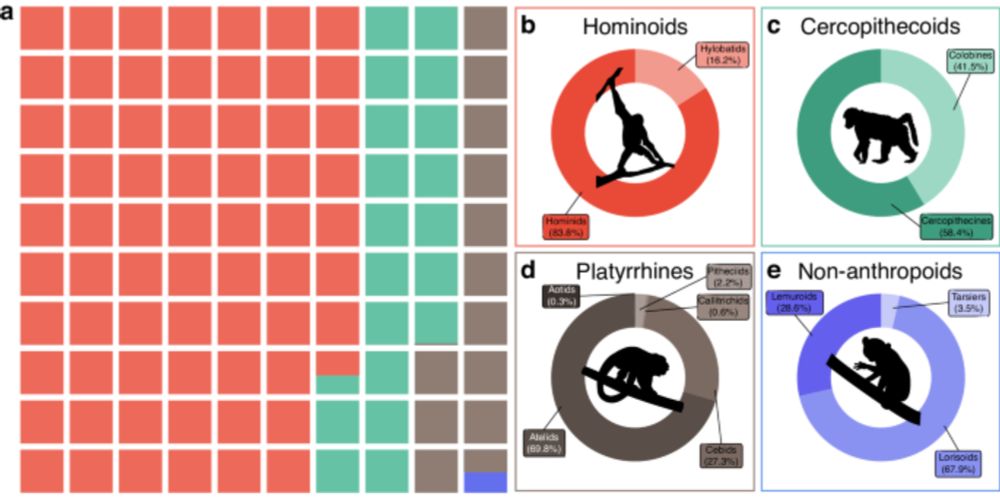
Primate Phenotypes: A Multi-Institution Collection of 3D Morphological Data Housed in MorphoSource - Scientific Data
Scientific Data - Primate Phenotypes: A Multi-Institution Collection of 3D Morphological Data Housed in MorphoSource
Our new paper announcing a freely available database of 3D scans of primate skeletal material--a major effort led by Sergio Almécija & his team at the American Museum of Natural History.
🧪 🏺 #paleosky #anatomy #primates #anthropology #morphology #zoology #paleoanthropology #openscience
18.12.2024 21:39
👍 85
🔁 48
💬 1
📌 5
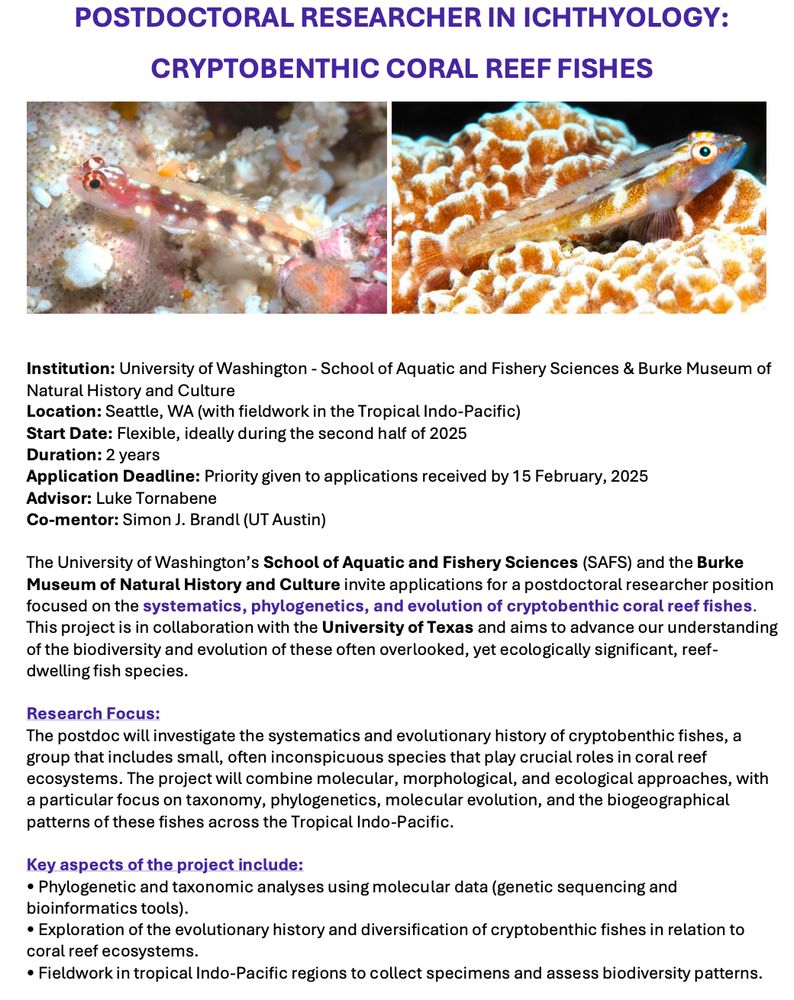
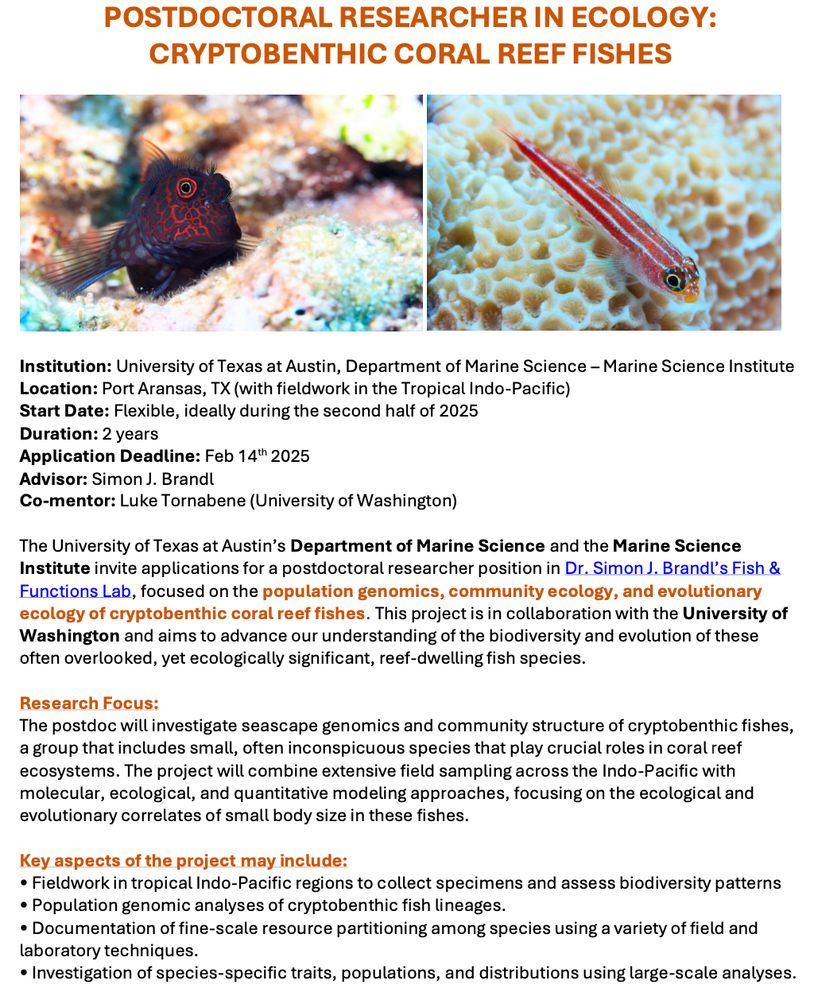
🚨New postdoc positions available: we are looking for 2 postdoctoral researchers to join a large, collaborative effort to document, describe, and investigate the biodiversity of tiny, cryptobenthic fishes in the Indo-Pacific 🤏🐠🧪. More details: fishandfunctions.com/join%F0%9F%9...
Please repost 🦑🧪
18.12.2024 22:09
👍 103
🔁 71
💬 1
📌 3

A time-calibrated salamander phylogeny including 765 species and 503 genes
Recent time-calibrated amphibian phylogenies agree on the family-level relationships among extant salamanders but had disparate sampling regimes and i…
Do you need a salamander phylogeny? You're in luck! We put together the largest salamander phylogeny to date based on molecular markers and used more fossil calibrations than any other currently available trees. 765 salamander species! Check it out!
www.sciencedirect.com/science/arti...
18.12.2024 23:54
👍 194
🔁 72
💬 7
📌 5


Realizing that I’ve basically become by dad… same beard, same sorts of glasses, same corny jokes… miss you dad
(can you tell which ones are me?)
15.12.2024 22:41
👍 2
🔁 0
💬 0
📌 0

A pair of Castorocauda on a partly submerged tree branch. One of the Mammaliforms has its head underwater looking at an aquatic salamander. A Pterosaur flies in the background
Quick sketch I did as a request from patron Flouder who suggested I sketched the Late Jurassic mammaliform Castorocauda lutrasimilis
#paleoart #sciart #sketch
12.12.2024 19:57
👍 311
🔁 77
💬 3
📌 2

Awesome image showing how birds can be so smart despite having small brains — more neurons packed into that small space (Olkowicz et al. 2016: www.pnas.org/doi/full/10....)
12.12.2024 20:01
👍 8
🔁 1
💬 1
📌 0
A ‘Second Tree of Life’ Could Wreak Havoc, Scientists Warn (Gift Article)
Research on so-called mirror cells, which defy fundamental properties of living organisms, should be prohibited as too dangerous, biologists said.
Over 30 prominent scientists call for a ban on the creation of a "mirror cell"--a microbe made of molecules that are mirror images of their natural forms. It could cause a mind-boggling global disaster. Here's my story [gift link] 🧪https://nyti.ms/3OUCXp6
12.12.2024 20:04
👍 1197
🔁 488
💬 93
📌 199
The birth of fruit fly's central nervous system imaged with multicolor #adaptive #lightsheet microscopy. The microscope self-aligns to a signal that appears during imaging.
www.nature.com/articles/nbt...
11.12.2024 20:32
👍 465
🔁 139
💬 10
📌 24

Diamond-shaped graph is broken down by type of mammal according to their populations' total biomass on Earth. Humans and cattle are each about 40%. Other domesticated mammals account for another 10% or so. Baleen whales like 4%.
Two zoomed in sections show wild terrestrial and wild marine breakdowns in detail. Rodents are like 15% of terrestrial mammals, artiodactyls are 30%. baleen whales are like 70% of wild marine mammal biomass.
Biomass of living mammals, compared! I knew the world was mostly humans and cows but I'm pleasantly surprised that baleen whales are a visible chunk due to pure size, rather than numbers. Original paper: www.pnas.org/doi/10.1073/...
(This was on other sites but I haven't seen it here with alt text)
12.12.2024 01:23
👍 19
🔁 4
💬 0
📌 0

This is the face of a shark! I've stained the mineralised tissues to show that their teeth and scales are both made of the same enamel-like material 🦈 🦷 🧪
11.12.2024 10:01
👍 309
🔁 72
💬 9
📌 11
Mine too!
11.12.2024 03:22
👍 1
🔁 0
💬 1
📌 0

New croc paper alert! 🐊🚨
In this new study led by my friend and colleague Thiago Fachini, we reassessed the cranial morphology and phylogenetic position of Barreirosuchus franciscoi, a peirosaurian from the Late Cretaceous of Brazil.
anatomypubs.onlinelibrary.wiley.com/doi/10.1002/...
02.12.2024 19:34
👍 41
🔁 13
💬 1
📌 0
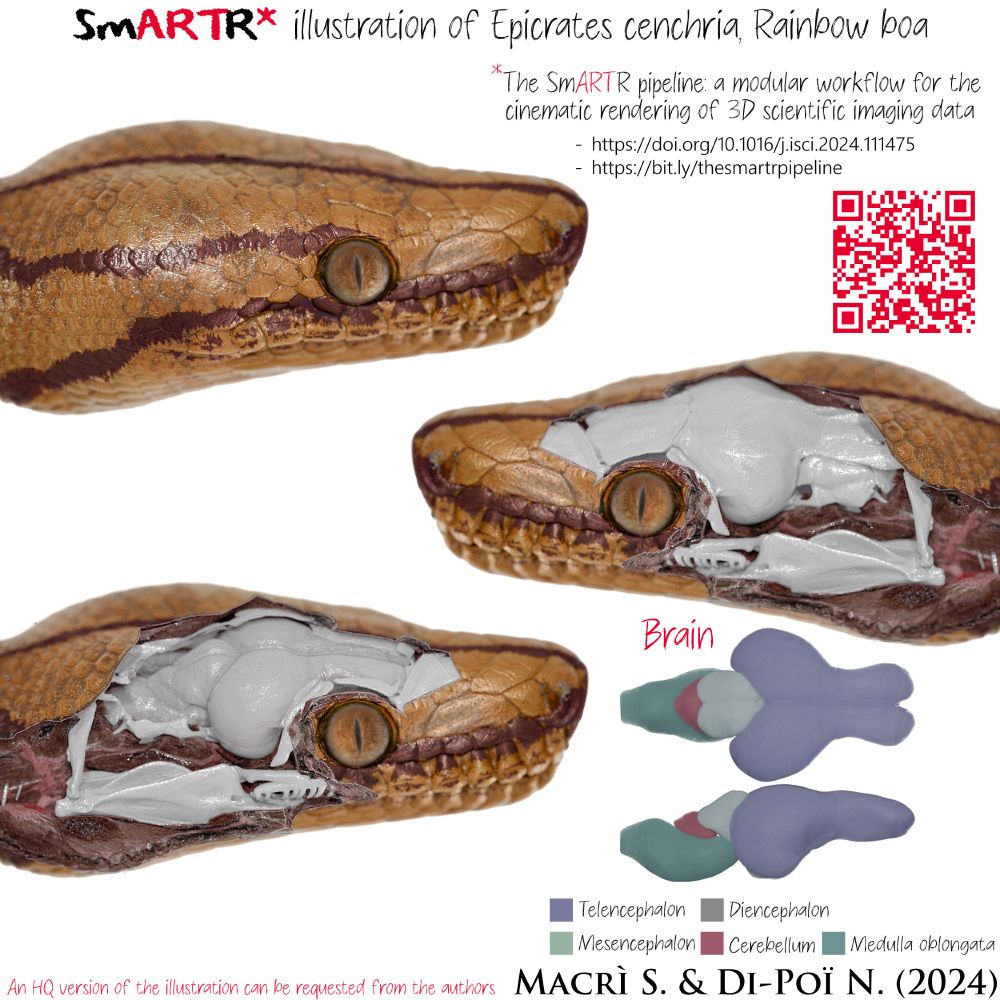
New snake renderings from CT scan data, created using our recently published SmARTR photorealistic pipeline! 🐍 Our manuscript is now in its final published form: doi.org/10.1016/j.is...
09.12.2024 11:02
👍 44
🔁 6
💬 2
📌 1
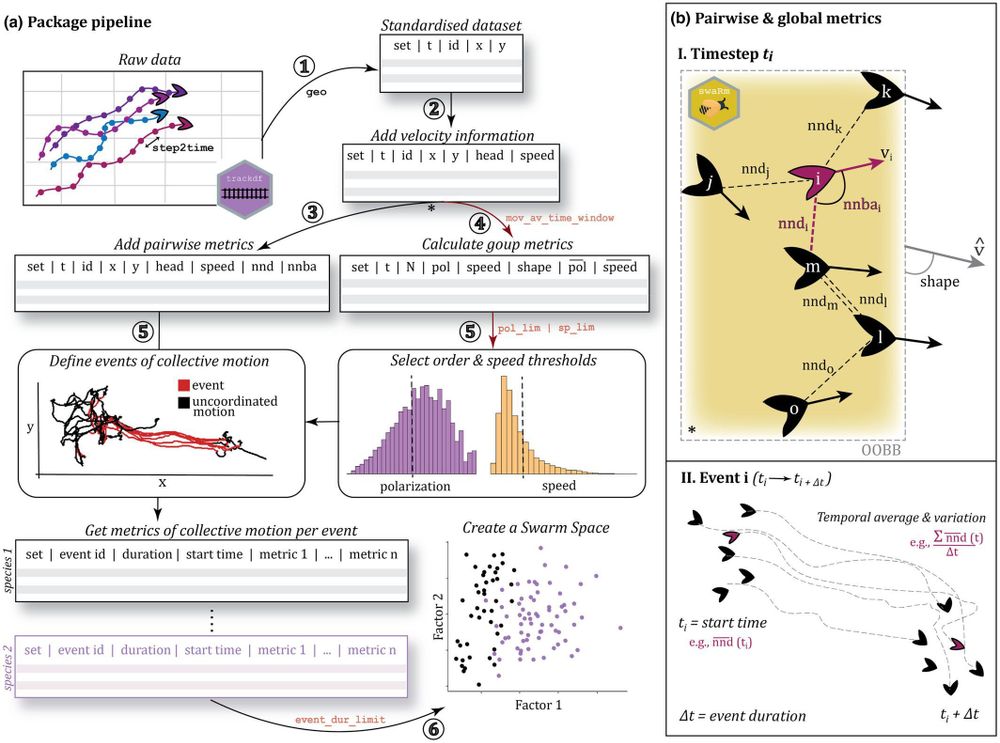
📖Published📖
In our new Application article, Papadopoulou et al. present the swaRmverse package, an R package for the comparative analysis of collective motion 🌎 🧪 Find out more here👇
https://buff.ly/3CSAEQW
08.12.2024 10:00
👍 35
🔁 11
💬 1
📌 0