I finally got aroud to deleting my X/Twitter account today. While I was at it, ChatGPT went to the curb too. I subscribed to Anthropic a couple of weeks ago anyway.
04.03.2026 00:22
👍 0
🔁 0
💬 0
📌 0

@westwoodastro.net
Son of Oregon, gadget junkie, Mac addict, retired USAF NCO (linguist/analyst), and former CTO in the real estate industry (retired^2). Practicing the dark art of astrophotography. http://astrobin.com/users/lthughes/
I finally got aroud to deleting my X/Twitter account today. While I was at it, ChatGPT went to the curb too. I subscribed to Anthropic a couple of weeks ago anyway.
Last night's skycam perspective of the lunar eclipse. #astrophotography #astronomy

I haven't had a telescope out since October, as I'm in rehab (for a back problem!). I went into my archival data this weekend and produced a very dusty image of Messier 45. Imaged from the driveway in 2019 and 2023.
I haven't had a telescope out since October, as I'm in rehab (for a back problem!). I went into my archival data this weekend and produced a very dusty image of Messier 45. Imaged from the driveway in 2019 and 2023. #astrophotography #astronomy

I tried my hand at vibe coding this week with Google's Antigravity. Within minutes, I had a working Python script that takes Pixinsight image annotation data, does Simbad queries, and generates a spreadsheet of info - and I can barely spell Python.
I tried my hand at vibe coding this week with Google's Antigravity. Within minutes, I had a working Python script that takes Pixinsight image annotation data, does Simbad queries, and generates a spreadsheet of info - and I can barely spell "Python." #astrophotography
I really don't miss the work trips since I retired!

Andromeda's maelstrom! Imaged over three nights in September from the driveway.
Andromeda's maelstrom! Imaged over three nights in September from the driveway. Image details are on my Astrobin page at app.astrobin.com/i/w0aubd. #astrophotography #astronomy
I'm in southern OR, about 35 mi north of the border.
Approximately 300 mi north of me!

The Pacman nebula (NGC 281), some 9500 LY from the center of my driveway. This was imaged with an 8" Celestron RASA and ZWO ASI2600MC camera with a dual narrowband filter.
The Pacman nebula (NGC 281), some 9500 LY from the center of my driveway. This was imaged with an 8" Celestron RASA and ZWO ASI2600MC camera with a dual narrowband filter. #astrophotography #astronomy

William Optics GT-81 telescope on the ZWO AM5 mount, outside waiting for dark.
I've got the William Optics GT-81 out this week. This scope never fails to deliver incredible views! #astrophotography #astronomy

My #astrophotography complaint about smoke on Twitter (remember that thing?) a few years ago was used in research on Wildfires.
Thanks!

A Daystar Quark solar filter attached to a Lunt 40mm etalon with 3D printed adapters.
Them: You don't need to double-stack a Daystar Quark solar filter. Me: A Quark double-stacked with a Lunt LS40F filter. I designed and 3D printed a couple of adapters. The ZWO ADC tames Newton's rings like magic. This project created many cloudy days in the PNW! #astrophotography #astronomy

Dwarf spiral galaxy NGC 6503 in the constellation Draco lies 18 million light years away on the edge of the Local Void.
NGC 6503, a dwarf spiral galaxy that lies 18 million light years distant in the constellation Draco and on the edge of the Local Void. Imaged with my 11" SCT over two nights this month. Image details on my Astrobin page at app.astrobin.com/i/au7oe5. #astrophotography #astronomy

Spiral galaxy NGC 6015 in the constellation Draco, approximately 60 million light years from Earth.
Spiral galaxy NGC 6015 in Draco, about 60 million light years from the center of my driveway. This is the result of nearly 12.5 hours of imaging over 3 nights in June. Image details are on my Astrobin page at app.astrobin.com/i/lcolg9. #astrophotography #astronomy
Thanks!
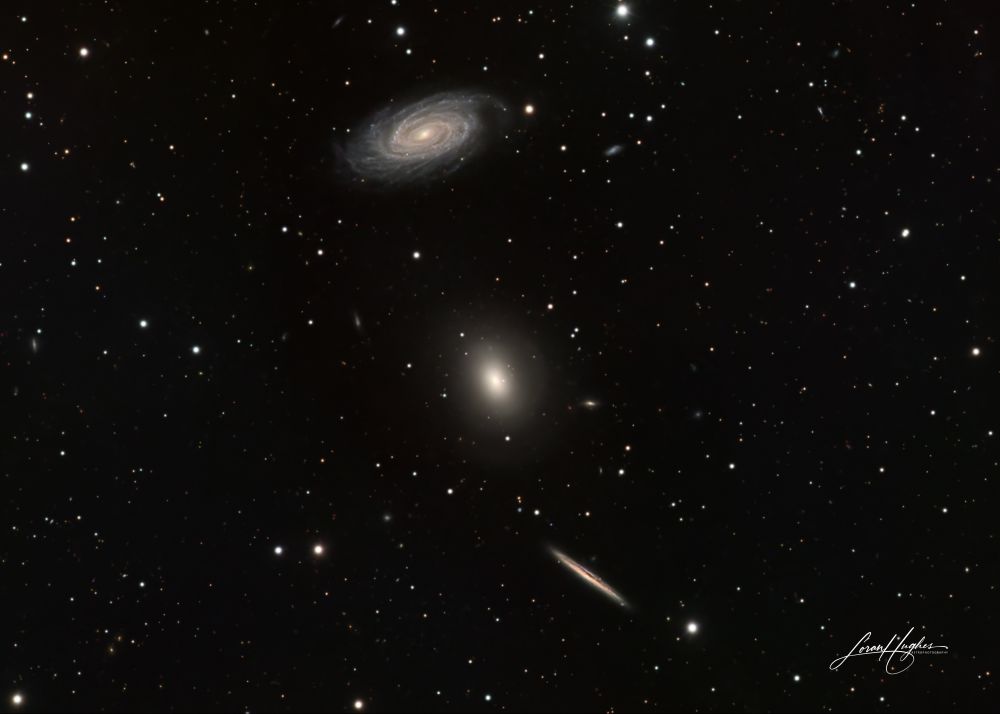
Draco Triplet galactic group.
The Draco Triplet, in the constellation (you guessed it) Draco! The spiral galaxy at the top (NGC 5986) is about a third larger than our Milky Way and 140 million light years distant! Image details on my Astrobin page at app.astrobin.com/i/jccmmy #astrophotography #astronomy
They landed on my 12th birthday. I was glued to the TV!
Having some renovations done on the house and and getting my #astrophotography fix is taxing on my old body. Late nights with the scope and early mornings with the contractor.

The galaxy group Hickson 44, about 80 million light years from our solar system.
This is how the galaxy group Hickson 44 looked some 80 million years ago, when dinosaurs roamed the earth. Photons collected with my RASA in 2020 and reprocessed this week! #astrophotography

I imaged this a couple of years ago in Ha-OIII-LRGB with my 8" EdgeHD. Very challenging to process! app.astrobin.com/i/lsx8eg
I've caught a daytime transit of the moon before. Fun stuff!
I suppose it depends on your desired results! Nico Carver has done some amazing work with a camera & tripod. Check out www.nebulaphotos.com.
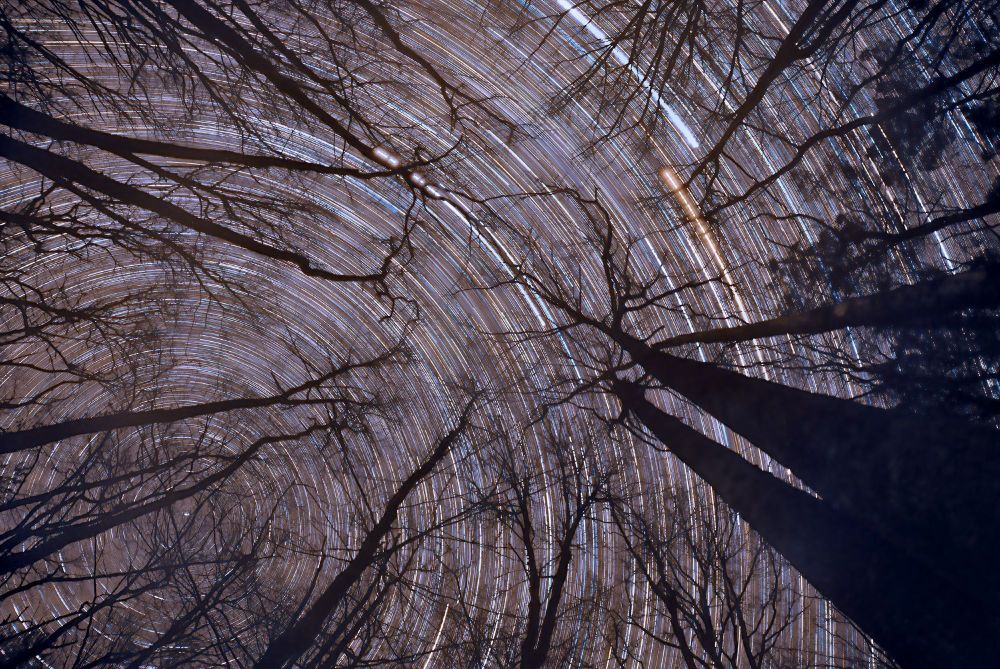
A long exposure photo showing star trails circling around Polaris above a forest. The trails form curved lines of varying colors—red, blue, and white—caused by Earth's rotation and each star’s spectral signature. Bare tree branches silhouette the foreground.
Star #Lines
This photo is a stack of hundreds of shots over 2 hours, revealing Earth's rotation.
Each star shows its spectral color, forming a palette dancing around Polaris, the near-static star near the celestial pole.
#blueskyartshow #circumpolar
Thank you!

Telescope at dawn.
The morning after the night before. Clouds have moved in, so I get a few nights off. #astrophotography

Keenan's system, a.k.a. Arp 104, in Ursa Major. Imaged from Southern Oregon.
Arp 104, Keenan's system in Ursa Major. A bridge of galactic material spans between the two galaxies as they interact. I had to dodge clouds for 3 nights to get this shot! Image details on my Astrobin page at app.astrobin.com/i/3hnqng. #astrophotography #astronomy
Thanks Bernd! More time always does wonders.
Thanks Darren. I'm at 42N, but our wildfire season can shut me down too. It's definitely a game for the patient among us!

Messier 63, the Sunflower galaxy. 19 hours, 6 minutes total integration time.
Messier 63, the Sunflower galaxy. Data from last year was combined with my imaging sessions from this spring to bump this to over 19 hours of total integration time from the driveway. Image details on my Astrobin page at app.astrobin.com/i/ql3yos. #astrophotography #astronomy
