Are AI Tools Ready to Answer Patients’ Questions?
This Medical News article discusses patient-facing artificial intelligence applications that are in various stages of development.
#AI tools are changing how patients access health info.
From explaining medical terms to proving postoperative instructions to digitizing informed consent, experts explore how these technologies may serve as “clinician extenders.”
ja.ma/4rbGEaH
06.03.2026 16:34
👍 2
🔁 3
💬 1
📌 0

JAMA Research Summary: A Decision-Support System to Personalize Antidepressant Treatment in Major Depressive Disorder. PETRUSHKA tool: 271 patients, Usual care: 269 patients. Rate of treatment discontinuation at 8 weeks: PETRUSHKA tool 17% vs Usual care 27%.
📊 Research Summary: Among adults with major depressive disorder, use of a web-based decision-support tool reduced early #antidepressant discontinuation and improved symptoms compared with usual care.
ja.ma/3MJmaYY
06.03.2026 15:00
👍 1
🔁 0
💬 0
📌 0

JAMA Insights: Using Numerical Comparisons to Help Patients Make Choices. Effective conversations with patients about risk are fundamental for shared decision-making. Table: Tools in the Comparison Toolbox with preferred/less informative communication.
💡 JAMA Insights: Numeric risk comparisons anchored in patient context may improve shared decision-making and help patients interpret clinical choices.
ja.ma/4rNpMbq
06.03.2026 14:00
👍 4
🔁 2
💬 0
📌 0

JAMA Research Letter: Climate Change and Health - Trends and Disparities in Heat-Related Emergency Medical Services Activations. Table displays EMS activation trends by population, 2019-2024, including heat-related data.
Heat-related EMS activations increased 65% from 2019 to 2024, with the fastest increases among middle-aged adults, lower-middle–income communities, and those in the Mountain and West South Central US.
ja.ma/4sqbpcZ
06.03.2026 13:00
👍 7
🔁 4
💬 0
📌 0

Infographic on fire safety, urging caregiver/child involvement for home fire prevention and safe evacuation. Includes tips like using back burners, keeping extinguishers handy, planning escape routes, staying low, and calling 911.
This JAMA Pediatrics Patient Page describes steps to promote fire safety, including fire prevention, the use of smoke alarms, and how to prepare a fire escape plan.
ja.ma/40LJM2a
06.03.2026 12:00
👍 3
🔁 0
💬 0
📌 1

JAMA viewpoint: 'A Yellow Book for Medical Devices—A Proposal for Public Health' by David A. Simon et al., published online January 29, 2026. Discusses FDA regulations, patent databases, and the creation of a Yellow Book for device innovation.
💬 Viewpoint: A proposed FDA “yellow book” could publicly aggregate medical device patent data, supporting oversight, research on device innovation, and detection of industry trends and device-related risks.
ja.ma/473EdQz
06.03.2026 12:00
👍 1
🔁 0
💬 0
📌 0

JAMA cover illustration titled "When I Grow Up" by Emma M. Cooke, MD, MA, published online March 5, 2026. It shows a doctor with a stethoscope examining a patient. "A PIECE OF MY MIND" is also printed on the cover.
"For everyone in medicine, not just medical students, our choice of specialty is just a single data point in what makes us who we are."
🖋️ Learn more in this essay by Emma Cooke, MD, MA.
ja.ma/4sk8Wkd
05.03.2026 17:30
👍 4
🔁 0
💬 0
📌 0

JAMAevidence JAMA Guide to Statistics and Methods; March 5, 17 min; Platform Clinical Trials for the Efficient Evaluation of Multiple...; JAMAevidence JAMA Guide to...; Play Button.
JAMA Statistical Editor @rogerjlewis.bsky.social, MD, PhD, and Steve Webb, MBBS, MPH, PhD, discuss the key features of platform trials, including adaptive structures, shared control groups, and domain-based randomization.
🎧 Listen now: ja.ma/3Pk33oU
05.03.2026 17:00
👍 5
🔁 5
💬 0
📌 0

Image shows information about skin cancer including symptoms and treatments. The text explains, "Keratinocyte carcinoma is skin cancer that develops in the outer layer of the skin." The types, Basal Cell and Squamous Cell Carcinoma, are also covered.
Keratinocyte carcinomas are skin cancers that develop in the outer layer of the skin.
📄 Learn more about the risk factors, signs and symptoms, diagnosis, and treatment in this JAMA Patient Page:
ja.ma/4skwZ2v
05.03.2026 16:45
👍 5
🔁 1
💬 0
📌 1

JAMA Guide to Statistics: The Hochberg Procedure for the Comparison of Multiple End Points. Analyses of clinical trials involve comparing patient outcomes. Text includes CME at jamacmelookup.com, details on P values, and method use.
📊 JAMA Guide to Statistics and Methods: The Hochberg procedure is a multiplicity correction used in clinical trials to control the familywise error rate when comparing multiple end points.
ja.ma/4b3yuep
05.03.2026 16:30
👍 6
🔁 0
💬 0
📌 1

Four scatterplots compare variable Rural Health Transformation Program (RHTP) funding per rural resident to state characteristics. Graph A plots mortality rate vs funding; B plots projected Medicaid spending decreases vs funding; C plots change in hospital beds vs funding; D plots change in rural physicians vs funding.
Current allocations under the Rural Health Transformation Program are inversely associated with rural mortality and hospital bed losses, indicating that funding may not reflect clinical need.
ja.ma/3OWHk6n
05.03.2026 16:15
👍 3
🔁 4
💬 0
📌 1

JAMA study on the PETRUSHKA tool for major depressive disorder. Population: 300 women, 220 men, median age 35. Intervention: 271 received the PETRUSHKA tool, 269 usual care. Findings: Treatment discontinuation at 8 weeks was 17% with PETRUSHKA tool, 27% with usual care.
In adults with major depressive disorder, the PETRUSHKA tool, which combines patient preferences and clinical predictors, was effective in personalizing antidepressant treatment and increased the likelihood of continuing treatment through 8 weeks.
ja.ma/4libFso
05.03.2026 15:00
👍 2
🔁 0
💬 0
📌 0

Info-graphic about hypothyroidism, its causes, symptoms, screening recommendations, and treatment with levothyroxine. Text includes: Fatigue, weight gain, dry skin, menstrual irregularities, infertility, high blood glucose in patients with diabetes.
This JAMA Patient Page describes hypothyroidism and its risk factors, signs and symptoms, diagnosis, screening, and treatment.
ja.ma/3ORz2g8
05.03.2026 14:00
👍 1
🔁 0
💬 0
📌 0

Table titled, 'Characteristics of US Adults With Uncontrolled Blood Pressure in 2021-2023 (continued).' It lists high-risk conditions and their relation to antihypertensive medication, noting percentages and P values.
Analysis of NHANES data from 2021 to 2023 found that 79.1% of US adults with hypertension had blood pressure above the 2025 American Heart Association/American College of Cardiology goal of <130/80 mm Hg.
ja.ma/4b9EUZK
05.03.2026 13:00
👍 5
🔁 0
💬 1
📌 0

JAMA viewpoint article, published online February 5, 2026. Titled: What Systemic Hormone Therapy Black Box Removal Means for Breast Cancer Survivors, by Versha Pleasant, MD, MPH; Kari Ring, MD. Article discusses MHT and breast cancer risks.
💬 Viewpoint: Removal of black box warnings for #menopausal hormone therapy reflects evidence that the risks and benefits vary by patient context, including hormone receptor status, formulation, and timing #postmenopause.
ja.ma/4b96cPW
05.03.2026 12:00
👍 3
🔁 0
💬 0
📌 1
JAMA Insights: "Using Numerical Comparisons to Help Patients Make Choices." Effective communication involves discussing risk and treatment options. Includes a table outlining tools like comparing alternatives, actions, and patient risks with others.
💡 JAMA Insights: Numeric risk comparisons anchored in patient context may improve shared decision-making and help patients interpret clinical choices.
ja.ma/4rYQr52
04.03.2026 17:00
👍 2
🔁 0
💬 0
📌 0

JAMA cover, "Picking Antidepressants—Patient Preferences Beat Biomarkers" by Gregory E. Simon, MD, MPH. Published online March 4, 2026. Article discusses antidepressant medication and treatment personalization.
💬 Editorial: Personalized #antidepressant selection using clinical criteria and patient preferences may yield better outcomes than biomarker-driven approaches for #depression.
ja.ma/4aOKZvL
04.03.2026 16:45
👍 3
🔁 0
💬 0
📌 0
JAMA Research Summary: A Decision-Support System to Personalize Antidepressant Treatment in Major Depressive Disorder. PETRUSHKA tool: 271 patients, Usual care: 269 patients. Rate of treatment discontinuation at 8 weeks: PETRUSHKA tool 17% vs Usual care 27%.
📊 Research Summary: Among adults with major depressive disorder, use of a web-based decision-support tool reduced early #antidepressant discontinuation and improved symptoms compared with usual care.
ja.ma/4l6OalT
04.03.2026 16:30
👍 1
🔁 1
💬 0
📌 0
JAMA infographic: The PETRUSHKA tool effectively personalizes antidepressant treatment for adults with major depressive disorder. Study of 300 women, 220 men, median age 35, across 47 sites. The PETRUSHKA tool showed a 17% treatment discontinuation rate at 8 weeks.
In adults with major depressive disorder, the PETRUSHKA tool, which combines patient preferences and clinical predictors, was effective in personalizing antidepressant treatment and increased the likelihood of continuing treatment through 8 weeks.
ja.ma/4aWDWBj
04.03.2026 16:15
👍 2
🔁 1
💬 0
📌 0

An excerpt from JAMA, published online February 4, 2026, titled "Management of Premenstrual Disorders." It lists guideline release date as December 2023 and developer as American College of Obstetricians and Gynecologists (ACOG).
📈 JAMA Clinical Guidelines Synopsis: The 2023 ACOG guideline recommends selective serotonin reuptake inhibitors (#SSRIs), used intermittently or continuously, as effective for managing affective symptoms of #premenstrual disorders.
ja.ma/3NgCCjo
04.03.2026 14:00
👍 3
🔁 1
💬 0
📌 1

JAMA article: "Nirsevimab vs RSVpreF Vaccine for Respiratory Syncytial Virus-Related Hospitalization in Newborns." Published online December 22, 2025. Article discusses study design, participants, exposures, outcomes, and measures.
Newborn #nirsevimab immunization was associated with lower risks of RSV-related hospitalization and severe outcomes compared to maternal #RSVpreF vaccination.
ja.ma/4bj1lga
04.03.2026 13:00
👍 3
🔁 0
💬 0
📌 0

JAMA, Journal of the American Medical Association, March 3, 2026, Volume 335, Number 9, Pages 735-830. This Week's Issue of JAMA, March 3, 2026. Includes articles on breast cancer screening, immunotherapy, hormone therapy and more.
📌 Editor’s Choice from this week's issue of JAMA:
➡️ Risk-Based vs Annual #BreastCancer Screening,
➡️ Precision Immunotherapy for #Sepsis,
➡️ IgA Nephropathy Review, and more.
ja.ma/3MSKPu7
03.03.2026 21:00
👍 0
🔁 0
💬 0
📌 0

A JAMA editorial titled "Precision Therapy for Sepsis: The End of the Beginning?" by Derek C. Angus. The article discusses precision therapy for sepsis, host-response patterns, and clinical trials involving SOFA scores.
💬 Editorial by JAMA Senior Editor Derek Angus, MD, MPH: The ImmunoSep RCT demonstrates the feasibility of biomarker-guided treatment, while highlighting ongoing challenges in immune classification and broader clinical application.
ja.ma/4u0WEzb
03.03.2026 17:15
👍 1
🔁 0
💬 0
📌 0

Infographic displaying JAMA research on immunotherapy for sepsis. It includes population data (183 men, 93 women, mean age 70), intervention details, and findings showing a 1.4-point decrease in mean SOFA score, with 35.1% improvement in the immunotherapy group vs. 17.9% in the control.
RCT: Among patients with #sepsis, a precision immunotherapy strategy targeting macrophage activation-like syndrome and sepsis-induced immunoparalysis improved organ dysfunction by day 9 compared to placebo.
ja.ma/4l60SkV
03.03.2026 17:00
👍 5
🔁 0
💬 0
📌 0

Illustration of IgA Nephropathy pathophysiology from JAMA. Four-hit hypothesis shows: 1) Aberrant IgA1 production; 2) Gd-IgA1 entering circulation; 3) Immune complex formation; 4) Complex deposition in glomerulus. Published online January 26, 2026.
IgA nephropathy is the most common cause of immune-mediated glomerular disease worldwide.
📄 This Review summarizes the pathophysiology, epidemiology, clinical presentation, diagnosis, treatment, and prognosis of primary IgA nephropathy in adults.
ja.ma/47bIhht
03.03.2026 16:45
👍 5
🔁 4
💬 0
📌 2

An article titled, "Unlocking the Potential of Risk-Based Screening for Breast Cancer From Detection to Prevention" by Nancy N. Baxter, MD, PhD; Kelly Anne Phillips, MD, published in JAMA online December 12, 2025.
💬 Editorial: Trialists found risk-based screening was as safe as annual screening for detecting advanced cancers but did not reduce breast biopsy rates.
ja.ma/3OCde8l
03.03.2026 16:30
👍 0
🔁 0
💬 0
📌 0
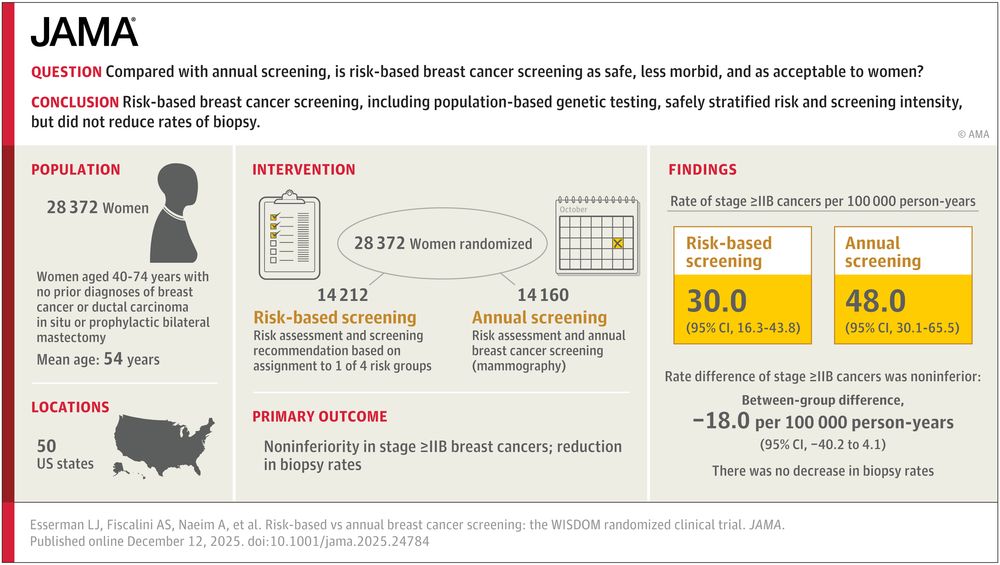
JAMA infographic comparing risk-based and annual breast cancer screening. Population: 28372 women, ages 40-74. Intervention: 28372 women randomized into risk-based (14212) and annual (14160) screening groups. Findings: Rate of stage text@1 cancers per text@2 person-years was 30.0 for risk-based vs 48.0 for annual screening.
The WISDOM study demonstrated that a risk-based approach successfully stratifies the population for breast cancer risk and is safe and acceptable to women.
ja.ma/4ldVU5K
03.03.2026 16:15
👍 2
🔁 0
💬 0
📌 0

JAMA RESEARCH LETTER titled 'Changes in Organ Donation After Circulatory Death in the United States'. Figure shows bar and line graphs of US trends in DCD, 2000-2025. Secular trends in DCD donation are shown, with DBD and DCD data.
Between 2000 and 2025, US donation after circulatory death (#DCD) increased from 2% to 49% of all deceased donors, driven by technologic advances in organ preservation.
ja.ma/4sk2LwA
03.03.2026 15:00
👍 1
🔁 0
💬 0
📌 0

JAMA article "The Lost Aura of the Physician in the Age of Artificial Intelligence" by John D. Lantos, MD. Text discusses AI's role in medicine, balancing technology with human presence, and Foucault's clinical gaze concept.
💬 Perspective: As #AI increasingly guides diagnosis, documentation, and patient management, physicians’ roles are changing, prompting questions about sustaining empathy, accountability, and trust in algorithmic care.
ja.ma/3OSAD5h
03.03.2026 14:00
👍 14
🔁 2
💬 0
📌 4