If navigation apps like Google Maps were invented today, they would be called "AI" and hyped as "AI agents." It's truly amazing how well they work, and now everyone completely takes them for granted, and many people completely outsource the mental task of navigation to them.
22.02.2026 18:08
👍 9
🔁 0
💬 0
📌 0
free video for intro lectures on auditory perception
08.02.2026 03:14
👍 119
🔁 23
💬 4
📌 3
Considering a big change to some slides, I find the Mitch Hedberg line to be apt: “I write jokes for a living, I sit in my hotel, I think of something that's funny, then I go get a pen and I write it down. Or if the pen is too far away, I have to convince myself that what I thought of ain't funny.”
02.02.2026 21:30
👍 2
🔁 0
💬 0
📌 0
it’s the point on the image plane that is nearest to the vantage point, so ‘nearest point’ or similar would be accurate, even if it’s somewhat unintuitive.
28.01.2026 22:57
👍 1
🔁 0
💬 0
📌 0
What is wild to me is the defense, BY THE NEURIPS BOARD, that fabricated citations do not mean "the content of the papers themselves [is] necessarily invalidated"
It does. It very much does. What do you think citing other work is for? What do you think writing a paper is for? What do you *think*?
21.01.2026 21:34
👍 250
🔁 76
💬 16
📌 12

Zeynep Tufecki on having the wrong nightmares about generative AI
I was writing a blog post where I was going to reference Zeynep Tufecki’s 2025 NeurIPS keynote, and realized there isn’t a solid synopsis online.
Wrote a summary of a great keynote by @zey.bsky.social at NeurIPS, arguing that we’re having the wrong nightmares about AI: not AGI or superhuman benchmarks, but good-enough genAI at scale threatens "load bearing frictions" society relies on to signal effort, authenticity, sincerity, credibility.
09.01.2026 16:42
👍 81
🔁 27
💬 2
📌 1
![Excerpt reads: "Prioritize your neighborhood
Neighborhoods drive our happiness (or unhappiness) more than we think.
When Lina Martinez, director of POLIS, the Center for Wellbeing Studies at Universidad Icesi in Colombia, studied the happiness of households in the city of Cali, she couldn’t find much difference between poorer and richer areas. “Their happiness is pretty much the same,” she said. But that changed when she isolated neighborhood conditions, such as access to transit, health care and parks. “The conditions of the neighborhood affect happiness,” she said. “I can’t link that to the space where [people] live.”
That aligns with findings from a 2023 study of the Vancouver metro area: Researchers found no significant differences in well-being between people living in single detached homes, duplexes, townhouses, laneway houses and apartment buildings (basement units smaller than 300 square feet were the only negative exception). What did people say they missed most in their neighborhood? Affordability, proximity to family and friends, and a sense of community. Home design was eighth on the list."](https://cdn.bsky.app/img/feed_thumbnail/plain/did:plc:ks3gpa6ftoyaq7hmf6c4qx4c/bafkreicapfknasylzk2lqzaxxeb5mchgnru75obggn45dusda6j5zogvuu)
Excerpt reads: "Prioritize your neighborhood
Neighborhoods drive our happiness (or unhappiness) more than we think.
When Lina Martinez, director of POLIS, the Center for Wellbeing Studies at Universidad Icesi in Colombia, studied the happiness of households in the city of Cali, she couldn’t find much difference between poorer and richer areas. “Their happiness is pretty much the same,” she said. But that changed when she isolated neighborhood conditions, such as access to transit, health care and parks. “The conditions of the neighborhood affect happiness,” she said. “I can’t link that to the space where [people] live.”
That aligns with findings from a 2023 study of the Vancouver metro area: Researchers found no significant differences in well-being between people living in single detached homes, duplexes, townhouses, laneway houses and apartment buildings (basement units smaller than 300 square feet were the only negative exception). What did people say they missed most in their neighborhood? Affordability, proximity to family and friends, and a sense of community. Home design was eighth on the list."
A Washington Post article suggests that, beyond a certain threshold, larger homes don't make people happier. Instead, well-being is correlated with affordable housing in walkable neighborhoods where they feel socially connected.
www.washingtonpost.com/climate-envi...
07.01.2026 04:29
👍 7153
🔁 1007
💬 197
📌 104
Hey everyone! I have enough publications to stop working for the rest of the year!
31.12.2025 05:34
👍 28
🔁 1
💬 3
📌 0
Wow, congratulations!
24.12.2025 19:39
👍 2
🔁 0
💬 1
📌 0


(But don’t worry, she gets lots of pampering and adventures.)
22.12.2025 14:11
👍 5
🔁 0
💬 0
📌 0

It’s tough to listen to recordings of my dog barking and howling intermittently while she learns to stay home alone, but I did like this auto-transcription produced by the audio recording app (Apple Voice Memos)
22.12.2025 14:00
👍 8
🔁 0
💬 1
📌 0
Congratulations! Time to update my bibtex file.
13.12.2025 06:19
👍 1
🔁 0
💬 1
📌 0

Most LLM evals use API calls or offline inference, testing models in a memory-less silo. Our new Patterns paper shows this misses how LLMs actually behave in real user interfaces, where personalization and interaction history shape responses: arxiv.org/abs/2509.19364
12.12.2025 20:42
👍 38
🔁 11
💬 1
📌 1
Seems like a metric that can be optimized for (gamed). Tweak your essay (manually or with help) until algorithm gives good marks. Requires access to same or similar AI.
12.12.2025 16:33
👍 1
🔁 0
💬 0
📌 0
Of course, multinational conglomerates aren't the best sources of edgy new stylistic innovation.
12.12.2025 03:38
👍 2
🔁 1
💬 0
📌 0

Back before text-to-image, people could appreciate the weird, surreal quality of GAN art. It evoked a lot of historical weird and surreal art, like Francis Bacon or Odilon Redon, without the baggage of today's "AI". See: arxiv.org/abs/1910.04639 .
12.12.2025 03:25
👍 6
🔁 0
💬 1
📌 0

People say that the new "AI"-based ads look like garbage, but the Brian Eno quote is relevant: people learn to appreciate the quirks of a style. The tastes here are about associations, e.g., if people who hate "AI" take the glitches as signifying "AI", then people will hate the glitches.
12.12.2025 02:17
👍 8
🔁 0
💬 2
📌 0
I think Doctorow means "reverse centaur" as something more general than an "accountability sink" (the term he uses). His reverse centaur is, basically, a person being operated by a machine, providing skills (vision, delivering packages, accountability) that the machine can't do on its own.
10.12.2025 22:25
👍 2
🔁 0
💬 1
📌 0
Thank you!
09.12.2025 14:57
👍 1
🔁 0
💬 0
📌 0
Would love to read more to get some concrete examples. What's the citation?
09.12.2025 06:44
👍 0
🔁 0
💬 1
📌 0
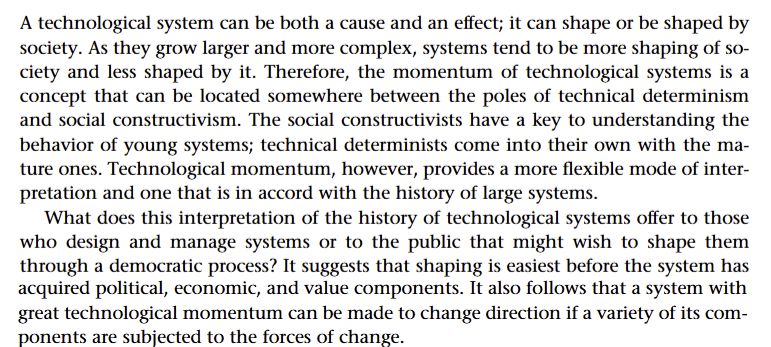
Historian Thomas Hughes argued that technologies are malleable when young, then harden. Right now we're still shaping AI, or at least it is being shaped by our institutions, norms & use cases
Eventually these systems build a momentum of their own. That is why choices now matter, things are fluid.
09.12.2025 00:20
👍 55
🔁 9
💬 3
📌 2
Descended from their ancient forebears, Queens of the Stone Age
06.12.2025 21:57
👍 3
🔁 0
💬 1
📌 0
*Ideally* the review decision takes the best parts of each of the reviews, and a bad or negligent review can be ignored rather than just "bringing the average down."
03.12.2025 03:42
👍 1
🔁 0
💬 2
📌 0
I agree, and it sounds like your view is very much aligned with the book. I also highly recommend his previous book "Status and Culture" which touches on these trends at the end.
02.12.2025 20:28
👍 2
🔁 0
💬 0
📌 0

How “AI”-Generated Imagery is Different From Previous Art Technologies
When text-to-image generation became big in 2022, many people reacted in shock. I heard a lot of people saying that nothing like this had ever happened before.
Modern Art devalued pure skill alone; the context, role, and story behind the work became central to its value, though skill is still valued in service of these elements. Perhaps we can expect similar reversals from the spread of Generative AI.
aaronhertzmann.com/2025/10/25/i...
7/
02.12.2025 18:53
👍 1
🔁 0
💬 0
📌 0
But something similar happened when photography was invented. Photographs radically challenged value of realistic pictures, which had previously required immense skill to create. This led to Modern Art and its reversals of value. In Van Gogh’s words, recreating reality was “just photography”.
6/
02.12.2025 18:33
👍 1
🔁 0
💬 1
📌 0

GenAI is Our Polyester
The best way to understand generative AI art and aesthetics is to consider how previous "synthetics" lost value in the long-run
For the first half of the 20th century, white-collar workers wore busin...
@wdavidmarx.bsky.social further argues that generative AI will accelerate poptimism's loss of value when cultural artifacts "can be made anywhere by anyone, and offer no useful social distinctions between philistine and aesthete”.
culture.ghost.io/genai-is-our...
5/
02.12.2025 18:27
👍 1
🔁 0
💬 1
📌 0
There is a lot to dislike about contemporary art, and it has had its share of idolizing money (Koons, Hirst), just as @wdavidmarx.bsky.social criticizes poptimism's love of financial success. Like all culture, it is messy. 4/
02.12.2025 18:24
👍 0
🔁 0
💬 1
📌 0


