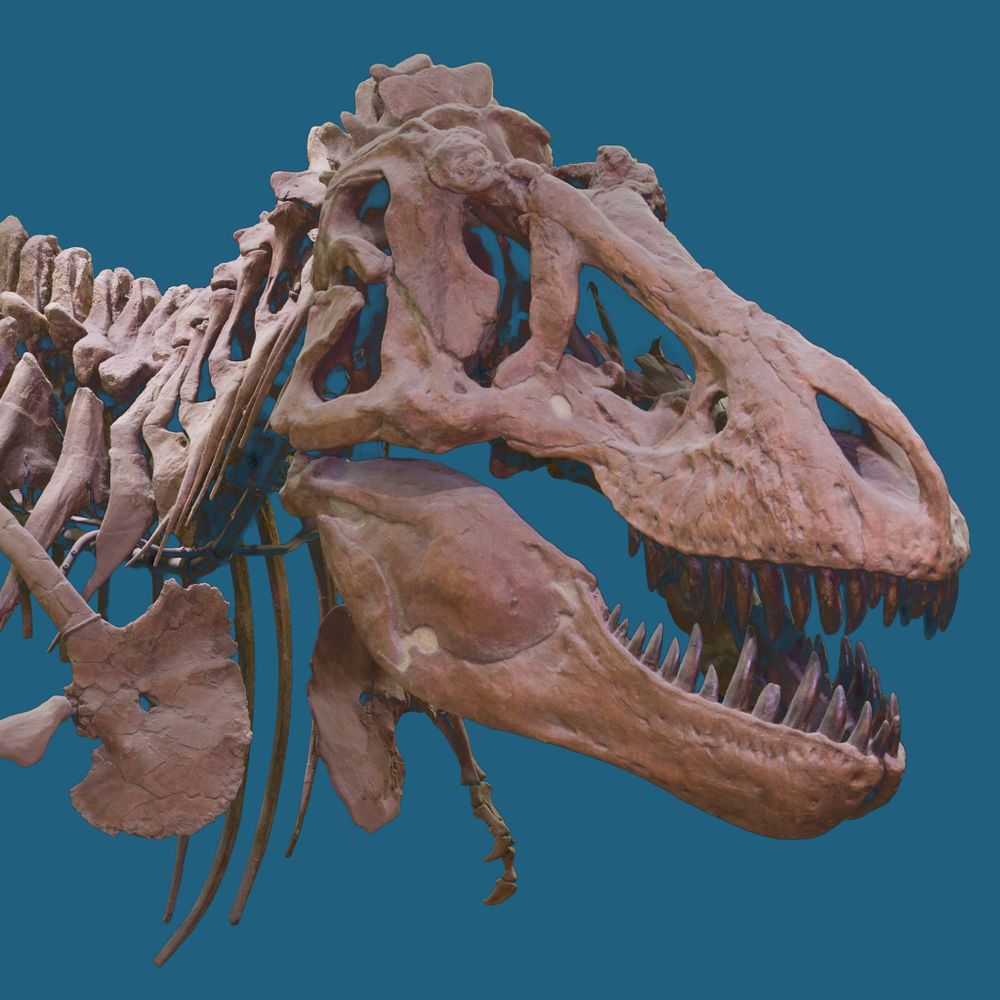
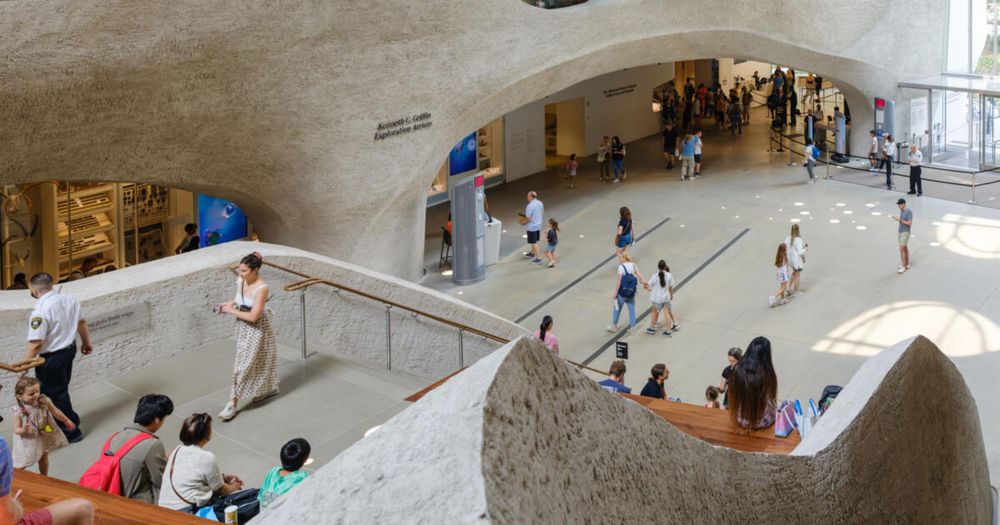
Spot this dinosaur, and so much more, at the Museum! Plan your visit: amnh.link/4lHPM4s
06.03.2026 15:14
👍 4
🔁 0
💬 0
📌 0
Spot this dinosaur, and so much more, at the Museum! Plan your visit: amnh.link/4lHPM4s

A photo of the head of pachycephalosaurus visible in profile. The animal has a beak-like mouth and a domed head.
This Fossil Friday, meet Pachycephalosaurus! It was once theorized that, like modern bighorn sheep, it used its skull as a battering ram. More recent studies have challenged this idea, suggesting Pachycephalosaurus may have knocked its opponents’ sides like modern day bison.

A photo of a Vancouver Island marmot sitting on a rock. The animal is chocolate brown in color with a pale snout and pale markings on its chest.
The Vancouver Island marmot is one of North America’s rarest mammals. By the early 2000s, fewer than 30 individuals remained. Since then, conservation efforts have bolstered its numbers to more than 400—however, it remains critically endangered.
Photo: Adam Taylor, CC BY-NC 4.0, iNaturalist

I was back at the @amnh.org for a new SciCafe talk. This was about the weakening of the Gulf Stream & climate change. The speaker, an oceanographer, talked how a new analysis changed his position on the subject which highlighted the self-correcting nature of science. Yay science! lol. #AMNH

A photo of a spectacled bear approaching the viewer. The animal is stocky with black fur. Its face is marked with gold, the pattern of which somewhat resembles a pair of spectacles.
Meet the spectacled bear! Also known as the Andean bear, it’s distinguished by the glasses-shaped marking on its face. An inhabitant of the tropical Andes, it’s currently the only extant bear species in South America.
Photo: Melvin TOULLEC, CC BY-SA 4.0, Wikimedia Commons

A photo of a Bornean pig. The pig is covered in brown hair and has a bushy, wiry beard.
Meet the Bornean bearded pig! This whiskered swine inhabits rainforests & mangroves in parts of Southeast Asia. It sometimes gathers in groups of 100+ individuals to migrate in search of fruit. It has the leanest torso & longest head of all living pigs.
Photo: rick_franks, CC BY-NC 4.0, iNaturalist

A recent study, led by Museum Research Associate Ernesto Vargas-Parra and Museum Curator Melanie Hopkins, suggests that trilobite heads were made of semi-independent modules and the number of modules decreased over metamorphosis—similar to butterflies or beetles! Read more about the findings.👇

A composite image. On the left, 3D scans of trilobite babies that are about the size of a grain of sand, revealing insight about their growth stages. On the right, a photo of a fossilized adult of the closely related species Lonchodomas rostratus. It has a long nasal appendage.
It's Trilobite Tuesday—and we have new research to share! On the left is a 3D scan of Lonchodomas chaziensis babies that are about the size of a grain of sand. The accompanying photo on the right shows an adult specimen of the closely related species Lonchodomas rostratus.
If the weather is clear, sky watchers in North America, Australia, and East Asia will have a view of a total eclipse of the Moon. Cloud cover and other atmospheric conditions may also affect the visibility and coloration of the Moon. The next total lunar eclipse won’t happen until June 26, 2029.

Image of the moon in the night sky. It appears reddish in color.
Blood Moon alert! Totality—when the Moon is fully immersed in Earth's dark umbral shadow & appears blood-red—will begin at 6:04 am ET on 3/3 in NYC & peak at 6:33 am ET. Totality will last for ~58 minutes, after which the Moon will begin to exit from Earth's shadow.
Photo: NASA/GRC/Jordan Salkin

A photo of a Malayan tapir looking at the viewer. The animal is black and white in color. It has a drooping proboscis.
Meet the Malayan tapir. This critter's unique nose (proboscis) helps it breathe while in water. Though it may be friend-shaped, give it space: It weighs ~1,000 lbs (450 kg) & can run faster than an Olympic sprinter!
Photo: John Clough, CC BY-NC 4.0, iNaturalist

A photo of a swimming platypus. It is covered in brown fur and has a black, duck-like bill.
With a duck-like bill, beaver-like tail, and the ability to lay eggs, the platypus has a lot going on. It lives in Australia, where it inhabits fresh water. It also happens to be venomous, inducing excruciating pain with its sting.
Photo: John Morton, CC BY-SA 2.0, iNaturalist

A close up photo of a sand cat peering at the viewer with narrowed eyes. Its coat is golden in color.
Meet the sand cat. Thick soles on its paws allow it to withstand the temperature extremes of desert sand. In parts of its range, days can reach 124° Fahrenheit (51° C) and then plummet to 31° Fahrenheit (-0.5° C) by night!
Photo: Cloudtail the Snow Leopard, CC BY-NC-ND 2.0, flickr
See Pteranodon and other prehistoric critters at the Museum! Plan your visit: amnh.link/4lHPM4s

An archival photo from the Museum’s collections of a Pteranodon skeleton on display. A man facing the specimen reveals its enormous size.
It’s a bird! It’s a plane! It’s… a dinosaur? Nope to all of the above. This #FossilFriday, let’s celebrate pterosaurs, flying reptiles that ruled the skies for 150+ million years. Some were as small as paper airplanes while others had wingspans bigger than an F-16 fighter jet!

A photo of a red panda curled up in a relaxed pose. Its fur is auburn, though darker at the belly and with white markings on its face. It somewhat resembles a lean raccoon.
Despite resembling the raccoon, the red panda is in its own distinct family: Ailuridae. Spending most of its life in the treetops, it uses its long tail as a counterbalance & can rotate its feet 180 degrees to aid it in gripping tree bark & branches.
Photo: Mathias Appel, CC0 1.0, Wikimedia Commons
This serves as an example of evidence of plate tectonics, which explains how continents move ever-so-slowly over the course of hundreds-of-millions of years.

Two photos of two different trilobites. One is tannish in color, the other is dark. Both have long spiny appendages.
t’s Trilobite Tuesday! Pictured above is a Ceratonurus trilobite from Oklahoma. Strikingly similar examples of this genus have been found some 4,970 mi (8,000 km) away in Morocco, such as the one pictured below.
😂

🔦Discover the Museum after dark before drifting off to sleep underneath the Blue Whale. From flashlight tours of our iconic halls to hands-on activities, scavenger hunts, group games, and more, this unforgettable program is designed to spark wonder.

A wide shot of the Museum’s Hall of Ocean Life. A life-size model of a blue whale is hanging from the ceiling as if it’s floating above the visitors below. Rows of cots are on the floor as families set up their sleeping bags.

A photo of the Museum’s Triceratops. The hall is dimly lit and a child is shining their flashlight on the Triceratops’ face.

Close up photo of a kid pointing his flashlight at the ceiling above him.

A group of kids are shining their flashlights into a glass case with the Deinonychus fossil inside.
🎟️Tickets will be available for A Night at the Museum: The Overnight Experience for the March, April, May, & June sleepovers starting on Tues, 2/24, at 10:30 am for Members at the Adventurer level & above. Tickets for the general public go on sale on Tues, 3/3, at 10:30 am.
Photos: A. Keding/© AMNH

A photo of the façade of the Museum's Gilder Center. There is snow on the ground and there are kids playing in it.
☃️Due to the winter storm, the Museum will be closed tomorrow, Monday, February 23.
🐻Take a cue from the bears—it’s a hibernation day. Stay safe, stay warm, and we’ll see you soon.
Photo: Alvaro Keding/©AMNH

A photo of a Pallas cat peering up at the viewer. It has a grayish coat of fluffy fur, long whiskers, and bright greenish eyes.
Caturday Mood? Pallas' cat. Found in parts of Asia, it lives a primarily solitary life & only seeks out company during mating season. A female Pallas’ cat produces a litter of one to six kittens, and by just 5 months old, they disperse to set out on their own!
Photo: pelican, CC BY-SA 2.0, flickr


Fun at the @amnh.org #Carnival!
See Deinonychus and other dinosaurs at the Museum! Plan your visit: amnh.link/4lHPM4s

A photo of the fossilized remains of Deinonychus mounted in a leaping position. The animal has a long tail, sharp teeth, and a slender body.
It's Fossil Friday! Meet Deinonychus antirrhopus. It belonged to a group of dinosaurs called maniraptors, or “hand-robbers.” Its hands & feet were equipped with sharp claws for catching & grasping prey. With its sickle claws & sharp teeth, it was likely a fierce predator.

An archival photo of the Museum’s Blue Whale suspended above the Hall of Ocean Life. The whale is blue in color with a speckled underbelly.
🐋 Throwback Thursday! On Wednesday, February 26, 1969, the Museum's Hall of Ocean Life and Biology of Fishes opened. The next Sunday, more than 35,000 people came to see the newly unveiled Blue Whale—setting a new attendance record.

A photo of a Senegal bush baby. It is standing on its hind limbs, facing away from the viewer. Its fur is gray, its eyes are large and brown.
Don’t greet the Senegal bush baby with a handshake! To mark its territory and improve its grip, this mammal urinates on its own hands! This nocturnal omnivore uses its large eyes and ears to find food, including seeds, eggs, and insects.
Photo: Petr Hamerník, CC BY-SA 4.0, Wikimedia Commons

Close up shot of a light brown trilobite fossil atop a pale rocky surface. The trilobite has an oval-shaped body with a ribbed carapace and smooth ends. Its head is facing the top left corner of the frame. It has a stalk on each side of its head with an eye atop each one, not unlike a pair of antennae. The background is black.
Welcome to Trilobite Tuesday! Pictured is Asaphus kowalewski. This 450-million-year-old species stands apart from other trilobites with its eyes perched atop 2-inch- (5-centimeter-) long stalks. To some, Asaphus kowalewski may look like an animal from a distant galaxy!

Head on shot of a brownish-red moth larva on a thin tree branch. It has little white spots on its body. Its silhouette looks not unlike that of a lobster. It's grasping the twig of a plant. The background is green.
Here’s one lobster that you might not want with a side of butter: the lobster moth! Named for its lobster-like larval form, this wide-ranging insect inhabits parts of Europe & Asia. While it resembles a crustacean, it can also mimic ants as a way to deter potential predators.