
It's been a great first few months at the EBI!
03.09.2025 09:28
👍 6
🔁 0
💬 0
📌 0
It's been a great first few months at the EBI!
Morph Map is now published in Nature Methods. Excited to see what the community discovers with this resource mapping ~15,000 human genes!
rdcu.be/ezGre
The visa is easy to obtain, for you and for any immediate family members. It allows a spouse to work in the UK.
Please reach out with any questions!
Project 7: Predict cellular phenotypes induced by environmental contaminants based on compound structure and cellular images using generative AI, in collaboration with Mo Lotfollahi (www.sanger.ac.uk/group/lotfol...)
Project 3: Decode morphological programmes of T cell activation through multimodal imaging and machine learning, in collaboration with @gosiatrynka.bsky.social (www.sanger.ac.uk/group/trynka...)

Check out this opportunity to join my lab as a postdoc! www.ebi.ac.uk/research/pos...
Every year, faculty from EMBL-EBI and the Wellcome Sanger Institute co-develop projects that allow fellows to be part of ✨both✨ of these amazing research institutes.
Two days left before the application closes!

We're once again hiring a summer (+?) #bioimage #bioimageanalysis #software intern! Due to requirements of the funding program, you must be a current student, as well as work onsite in MA (+ have US work permission). Details at the link below. Spend your summer making great tools with fun people!
Two EMBL-specific quirks:
- EMBL salaries are "after tax", so the stated salary is roughly equivalent to $70k USD
- Employees qualify for a quick & inexpensive visa exemption that allows them and their spouse/children to work in the UK (my visa was processed in 2 days and cost me $50USD)
🚨 We're hiring! 🚨 The Ewald Lab at EMBL-EBI is looking for a postdoctoral researcher in multi-omics, machine learning, and predictive toxicology to analyze a groundbreaking toxicology dataset as part of the OASIS Consortium.
More details & application here: lnkd.in/eHD7DMdX
We link molecular and functional phenotypes of islet cells from donors with type 1 diabetes to understand impaired insulin and glucagon secretion. Immune signalling, nuclear exclusion, mTOR and lysosomes in alpha cell dysfunction.
https://www.biorxiv.org/content/10.1101/2025.02.20.639325v1
6/ Huge thank you to my co-authors at Axiom who were wonderful to work with, as well as to the entire OASIS Consortium.
5/ These findings demonstrate the potential of image-based profiling as a sensitive, animal-free, early-stage screening tool for compound toxicity.
4/ We found that the morphological profiles detect compound bioactivity at lower concentrations than standard cytotoxicity assays. In supervised analyses, they predict cytotoxicity and targeted cell-based assay readouts, but not cell-free assay readouts.
3/ We then use supervised machine learning to predict diverse in vitro assay readouts relevant to mode-of-action and cell state using image-based profiles. We also investigate optimal strategies for extracting information from images to make mode-of-action predictions.
2/ High-throughput, human-relevant approaches for predicting chemical toxicity are urgently needed.
In our new preprint, we use Cell Painting and cytotoxicity assays to profile >1000 compounds in primary human hepatocytes, including pharmaceuticals, pesticides, and industrial chemicals.

First large-scale analysis of chemical toxicity in primary human hepatocytes!
www.biorxiv.org/content/10.1...

Image of the job posting (see URL for full text instead)
We've a postdoc opening for our lab at the Broad: Cambridge MA!
Must have experience in toxicology + data science
Work on the wonderful OASIS dataset we are producing... Cell Painting, transcriptomics, proteomics in various liver cell and tissue models!
broad.io/mlcbpostdoc
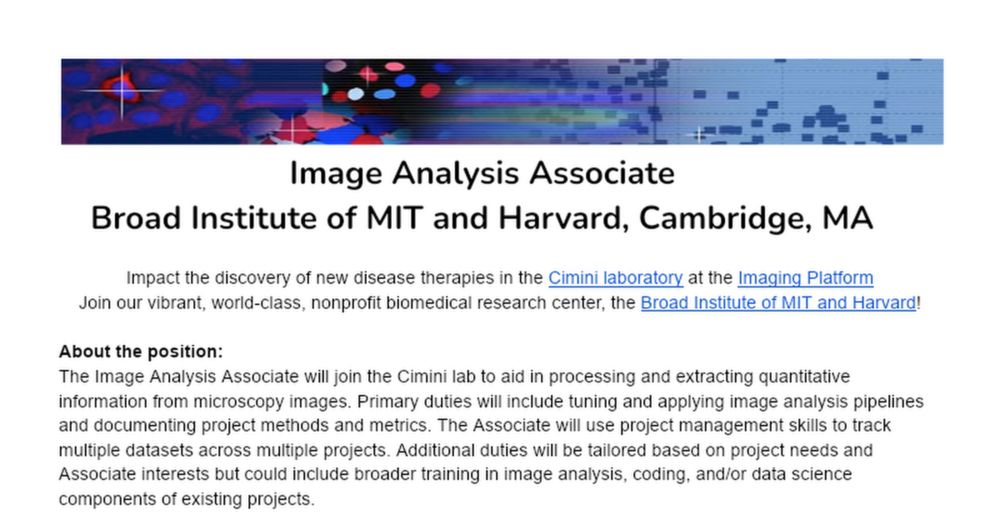
New Year, new job? Delighted to announce two early-career-level (post-BA/BS or MA) positions in my lab, and an open call for computational postdocs at the Broad!
First, an image analysis associate - work on high content screens for all kinds of cells and dimensionalities! See more at link (1/4)
Thanks, I'll try make it out! This is right after I move.
I think about macromolecules a lot, but mainly as either targets of small molecules that cause target-mediated toxicity, or as something that we can measure at scale (omics data) to detect toxicity.
Thanks! Looking forward to starting!

🎉 I'm starting my own lab at EMBL-EBI (Cambridge, UK; June 2025) 🎉
We will focus on identifying and characterizing chemical hazards to humans and ecosystems using computational biology methods.
I am beginning the search for two postdocs now - stay tuned for more details!
ewaldlab.org
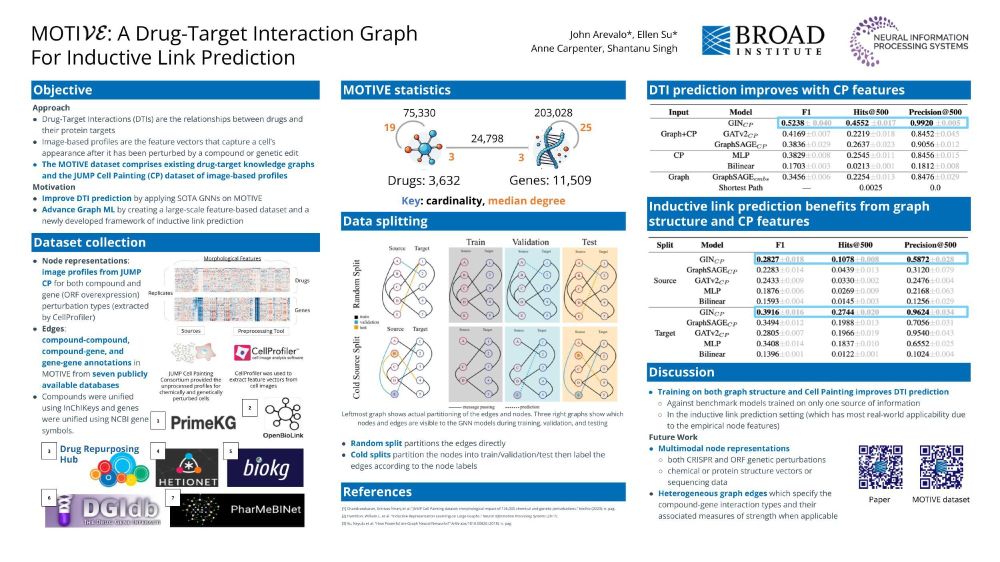
Excited to present our spotlight paper at #NeurIPS!
MOTIVE is a new dataset + benchmark for predicting drug-target interactions, using Cell Painting data
Location: Fri 13 Dec 4:30 p.m. PST @ East Exhibit Hall A-C #4208
Poster: neurips.cc/virtual/2024...
Paper: arxiv.org/abs/2406.08649
A new paper from the Carpenter-Singh Lab - such a cool project and I'm really excited about the possibilities that these data will unlock for future projects!

Really loved the concept of distinguishing between 'fun challenge stress' and 'threat stress' on this Ologies podcast on burnout: open.spotify.com/episode/0ccV...
Reflecting on my own work patterns as I mentally prepare to start my own lab.
Any tips out there?

The 2024 biennial survey by COBA, @bioimagingna.bsky.social, @royalmicrosoc.bsky.social and @globias.bsky.social is here to connect imaging users with image analysis. Check this out @biologists.bsky.social for more details - focalplane.biologists.com/2024/11/13/b...
