So, when a company's directors care about the environment, it tends to adopt pro-climate policies. At a moment when companies are walking away from their climate commitments, our paper shows the benefits of empowering corporate leaders who value and support climate action 4/4
01.05.2025 19:37
👍 1
🔁 0
💬 0
📌 0
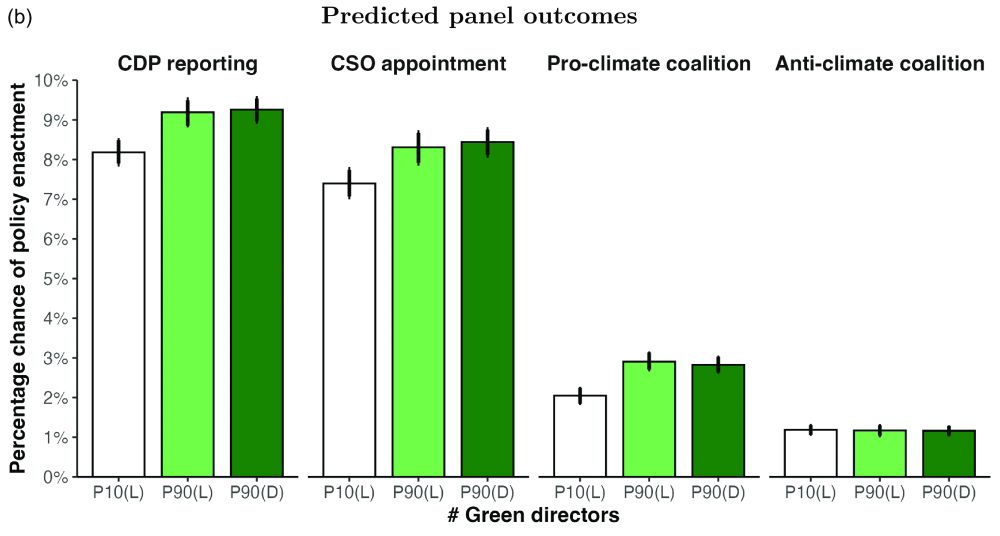
A predicted values plot showing an increase in the probability reporting GHG emissions, appointing a CSO, and membership in a pro-climate coalition as the number of green directors on a board increases from the 10th percentile to the 90th percentile. The plot also shows no change in the probability of joining an anti-climate coalition.
And does having green directors on the board matter? Yes!
Firms with more green directors are more likely to:
- report GHG emissions voluntarily
- appoint a chief sustainability officer
- join pro-climate political coalitions
- announce a Net Zero commitment (ambitious ones!)
3/4
01.05.2025 19:37
👍 1
🔁 0
💬 1
📌 0
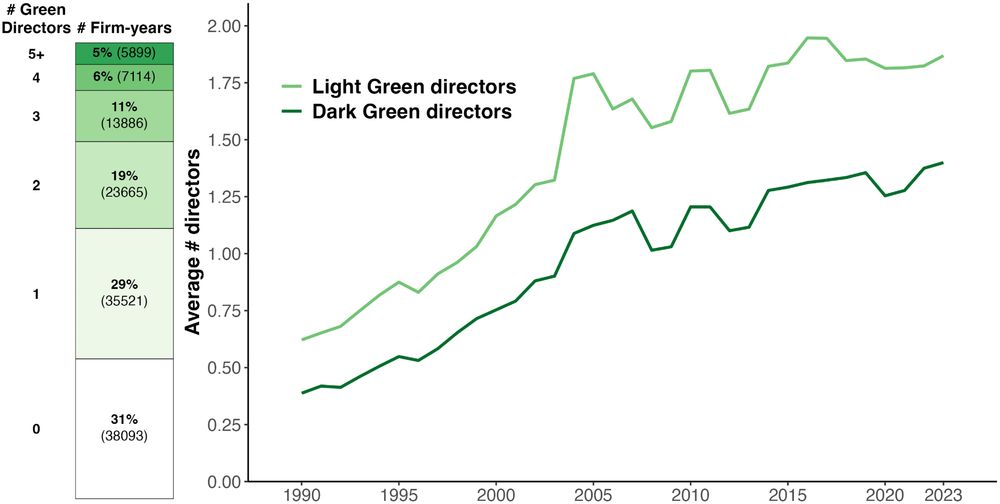
Left: A bar chart showing Green Directors by firm-year. 31% have 0 directors, 29% have 1, 19% have 2, 11% have 3, 6% have 4, and 5% have 5 or more Green Directors. Right: A line graph with the x-axis showing the years 1990 to 2023 and the y-axis showing the average number of directors per firm-year from 0 to 2. Two roughly parallel lines represent Light Green and Dark Green directors, rising from about 0.5 in 1990 to about 1.5 in 2023.
It might not feel like it right now, but pro-environmental attitudes are more common among Corporate America’s leaders than ever. Today, about 1 in 4 directors at the average firm give primarily (or solely) to political candidates endorsed by green PACs – twice as many as in the 1990s 2/4
01.05.2025 19:37
👍 0
🔁 0
💬 1
📌 0
Greens in the boardroom: director attitudes and corporate climate policy | Business and Politics | Cambridge Core
Greens in the boardroom: director attitudes and corporate climate policy
With the US walking back its environmental policies, where can activists find meaningful wins for the climate? One answer is to focus on getting people who care about the climate crisis onto corporate boards
Why? A short 🧵 on my new article w/ Iain Osgood doi.org/10.1017/bap.2025.6 #polisky 1/4
01.05.2025 19:37
👍 1
🔁 1
💬 1
📌 0

Karl’s defense

Karl’s dissertation on the politics of green industrial policy


A pleasure to come to Aarhus and participate in a fantastic PhD defense by Karl Magnus Møller yesterday. Thanks to @henrikseeberg.bsky.social for inviting me as external examiner and the political science community at Aarhus for a great visit. What a lovely community - and ofc, city -they have 💫🇩🇰
12.04.2025 06:50
👍 23
🔁 1
💬 3
📌 2
This matches lots of things @michaelhlerner.bsky.social, I and others mapped in our World Bank study on CO2 pricing in GS:
openknowledge.worldbank.org/server/api/c...
Our expert interviews/surveys also say that in emerging economies CO2 trading is top choice but issues of public acceptability bite
08.04.2025 15:09
👍 7
🔁 3
💬 0
📌 0
Many many thanks to my wonderful team of co-authors, including @fgenovese.bsky.social and @gard-murray.bsky.social, as well as the carbon pricing experts who generously participated in the study!
7/7
17.12.2024 19:22
👍 1
🔁 0
💬 0
📌 0
To sum up:
1) Some aspects of carbon pricing seem to have conflicting implications for technical effectiveness vs political feasibility
2) Feasibility concerns sometimes trump effectiveness, suggesting experts are attuned to the political risks of carbon pricing in developing countries
6/7
17.12.2024 19:22
👍 1
🔁 0
💬 1
📌 0
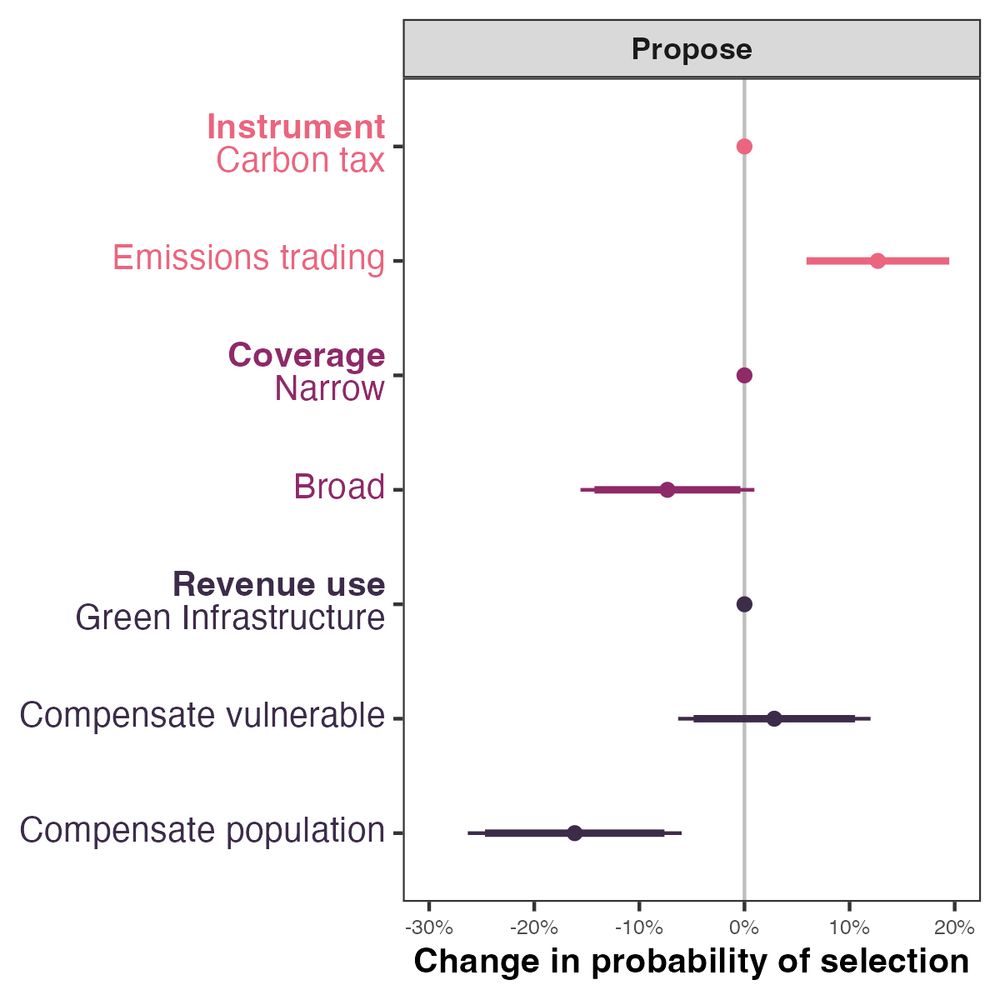
A coefficient plot showing the probability of proposing the instrument, coverage, and revenue use policy design choices
_Preferences_
When asked which policy they would propose to a policymaker, the experts preferred
• Emissions trading over a tax (no trade-off required)
• Broad coverage over narrow
• Revenue use for green infrastructure or vulnerable populations – but definitely not for the general public
5/7
17.12.2024 19:22
👍 1
🔁 0
💬 1
📌 0
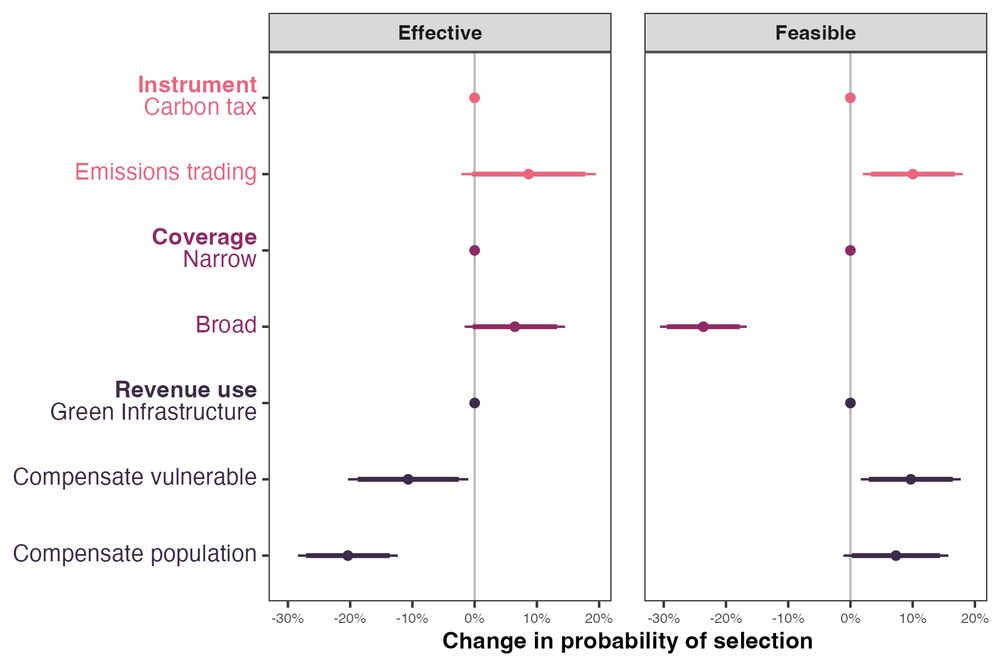
A coefficient plot with facets for effectiveness and feasibility and estimates for instrument, coverage, and revenue use
_Perceptions_
Experts say emissions trading is similarly effective and more politically feasible than a carbon tax
A broad policy seems similarly effective as a narrowly targeted one, but far less feasible
Spending funds on compensation is seen as less effective but more politically feasible
4/7
17.12.2024 19:22
👍 1
🔁 0
💬 1
📌 0
![In the context of Carbonia, consider the following designs: [table with two policies and designs for instrument, coverage, and revenue use]. Which would be more technically effective (reducing emissions)? Which would be more politically feasible (easily adopted)? Which would you propose to the policymaker?](https://cdn.bsky.app/img/feed_thumbnail/plain/did:plc:5wyjqwfaotagdzr6xz7bjrqk/bafkreicqz3lxursech56lrj5mnm3acg2rakezlmoo7q33bwbpwhnmxljeq@jpeg)
In the context of Carbonia, consider the following designs: [table with two policies and designs for instrument, coverage, and revenue use]. Which would be more technically effective (reducing emissions)? Which would be more politically feasible (easily adopted)? Which would you propose to the policymaker?
As part of a larger survey (hdl.handle.net/10986/42093), we asked experts to choose between alternative designs for a carbon pricing policy in Carbonia, a fictional developing country with relatively strong government capacity, high inequality, and substantial oil and gas production.
3/7
17.12.2024 19:22
👍 0
🔁 0
💬 1
📌 0
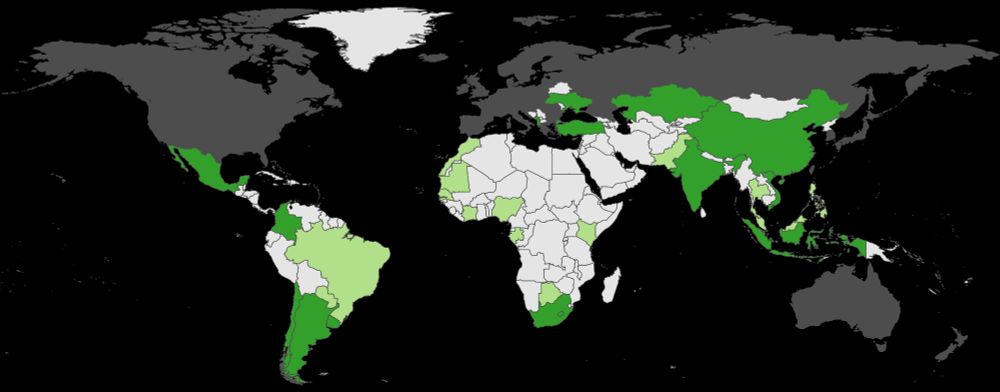
A world map showing the adoption and consideration of carbon pricing
Carbon pricing isn't just for wealthy countries! The policy has already been adopted by 16 developing countries (dark green) & is under consideration in more than a dozen others (light green)
Why do Global South policymakers prefer some carbon pricing policies over others? We investigated 🔎
2/7
17.12.2024 19:22
👍 0
🔁 0
💬 1
📌 0
Can confirm this. In expert interviews with @michaelhlerner.bsky.social and others for the World Bank (~1 year ago), CBAM came up as a clear justification for why Global South countries are engaging with carbon pricing.
If interested, our report is here: openknowledge.worldbank.org/entities/pub...
04.12.2024 15:34
👍 12
🔁 6
💬 1
📌 3
Interesting read. If you are into experts’ take on carbon pricing specifically in the Global South, here is a World Bank report that @michaelhlerner.bsky.social and I and others have put together, out a month ago:
bsky.app/profile/mich...
14.11.2024 09:40
👍 7
🔁 6
💬 0
📌 0
Despite political distractions, the first 100 days of #climatechange governance under the #Labour government has gone (surprisingly) well! How so? I explain in my new post on the @lsegovernment.bsky.social blog (+ other excellent contributions by @lauraserra.bsky.social & Prof. Tony Travers)
14.10.2024 15:53
👍 2
🔁 1
💬 0
📌 0
I’m proud to have led this project team in collaboration with @gard-murray.bsky.social and @fgenovese.bsky.social, as well other researchers from LSE Consulting and adelphi Consult!
16.09.2024 11:59
👍 2
🔁 1
💬 0
📌 0
Open Knowledge Repository
New #WorldBank report! While the politics of #carbonpricing involve compromises and accommodations, real-world experiences show it can be a powerful, powerful, and politically feasible tool for accelerating #decarbonization in developing countries.
openknowledge.worldbank.org/entities/pub...
16.09.2024 11:56
👍 16
🔁 6
💬 1
📌 1
As the clock starts to run out on the clean energy transition, we are seeing an increasing trend of states taking back local authority on siting decisions. Most recently we've seen this in Midwestern states. Now Massachusetts is exploring:
commonwealthbeacon.org/energy/commi...
13.04.2024 17:58
👍 0
🔁 1
💬 0
📌 0