The time series above show variations of coastal MDT, alongshore current, and derived quantities on timescales >15 days. Tidal signals are averaged out (we checked that there is no aliasing).
28.01.2025 12:28
👍 0
🔁 0
💬 0
📌 0
This highlights the value of using geodetic MDT estimates for model validation and ocean monitoring, making this study relevant for both the modeling and observation communities. 🌊 (5/5)
27.01.2025 19:04
👍 0
🔁 0
💬 1
📌 0

Low-pass-filtered time series of the alongshore tilt of MDT at the coast of Nova Scotia and related quantities. (a) Mean alongshore depth-averaged current predicted by GoMSS (blue) and estimated from wind-corrected tilt of predicted MDT (black). (b) predicted by GoMSS (black), diagnostic of area-integrated nearshore circulation (red), area-integrated JEBAR (blue), and flow across isobaths (green). The model output was integrated over the area enclosed by the red polygon in Fig. 1. A third-order Butterworth low-pass filter with a cutoff frequency of 15 d was applied to the time series to remove high-frequency variability and thereby allow a quasi-steady state to be assumed.
Combining theory, idealized models, and a regional ocean circulation model, we offer two complementary and dynamically consistent interpretations linking this tilt of MDT to the alongshore current and also to the area-integrated nearshore circulation. (4/5)
27.01.2025 19:04
👍 1
🔁 0
💬 1
📌 0

Predicted MDT (black line) and contributions by individual terms in the alongshore, depth-averaged momentum balance at the coast on the Scotian Shelf: wind stress (ηW), bottom friction (ηBF), and lateral mixing (ηLM) as well as their sum. The contribution from the depth-averaged baroclinic pressure gradient is also shown (gray line). Note that the mean of each term has been subtracted to center the curves around zero. Alongshore locations of the tide gauges are shown by their respective abbreviation.
This includes an alongshore tilt of MDT associated with the Nova Scotia Current that is balanced primarily by wind stress, bottom friction, and a small contribution from lateral mixing. (3/5)
27.01.2025 19:04
👍 0
🔁 0
💬 1
📌 0

Predicted and observed mean dynamic topography (MDT). (a) MDT predicted by GoMSS (spatial median value over an area where water depth < 200 m is removed). Markers indicate the locations of the coastal tide gauges listed in Table 1. The line separates the upper Bay of Fundy where the model has difficulty resolving the residual circulation due to the limited resolution. (b) Coastal MDT as a function of distance along the coast of the Gulf of Maine and Nova Scotia. The minima in Minas Passage (−28 and −25 cm, respectively) are not shown. Geodetic estimates of MDT are shown with their respective uncertainty. The shaded area indicates the coast along the upper Bay of Fundy. Panels (c) and (d) show enlarged views of either side of the shaded area in (b). In panels (b)–(d), the means of the respective observations and predictions at the grid points closest to the tide gauges have been removed.
MDT (the local height of sea level above the geoid) can be estimated by coastal tide gauge observations in combination with the latest generation of geoid models. These new geodetic estimates can be used to validate MDT predictions by regional high-resolution ocean models. (2/5)
27.01.2025 19:04
👍 0
🔁 0
💬 1
📌 0
Very excited to be at #AGU24 this week! I’m looking forward to lots of science, meeting old friends, and making new connections. Let’s get in touch!
Here’s where you can find me:
09.12.2024 01:16
👍 0
🔁 0
💬 1
📌 0
Gold wrote a brief BAMS note about this in 1963, in response to a request from Phillips.
He notes that he believes the earliest note was in a glossary of his 1907 paper, where there was some evident advantage in separating the Coriolis component from the centrifugal effect in gradient wind 2/🌊
26.09.2024 14:22
👍 1
🔁 1
💬 1
📌 0

The model also predicts that the atmospheric circulation in response to the MJO leads to anomalous upwelling on the Scotian Shelf. (5/5)
07.05.2024 10:21
👍 0
🔁 0
💬 0
📌 0

The observed relationship between the MJO and North Atlantic SST can be captured by a regional ocean circulation model demonstrating their feasibility and potential for S2S ocean prediction. (4/5)
07.05.2024 10:20
👍 0
🔁 0
💬 1
📌 0
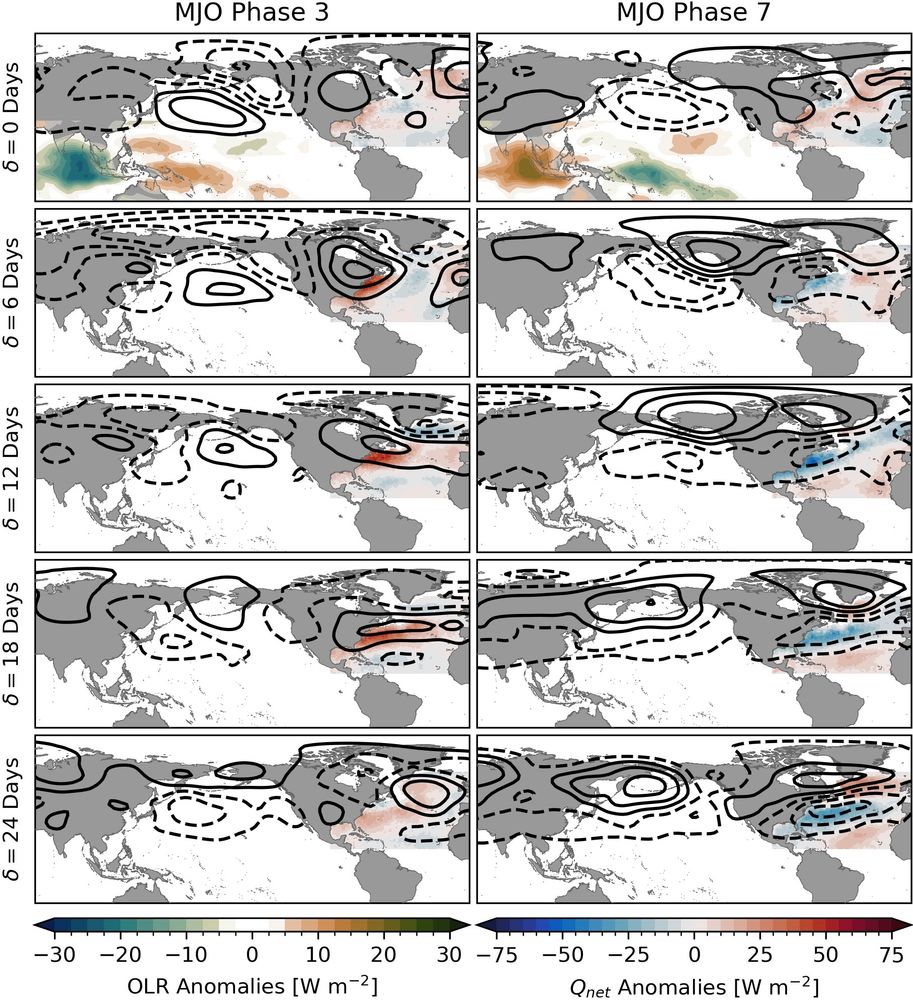
These changes are driven primarily by anomalous air-sea heat fluxes caused by large-scale atmospheric perturbations linked to the MJO. (3/5)
07.05.2024 10:20
👍 1
🔁 0
💬 1
📌 0

Statistically significant large-scale #SST changes in the North #Atlantic, particularly along the eastern seaboard of North America, can be related to the MJO. (2/5)
07.05.2024 10:17
👍 1
🔁 0
💬 1
📌 0
Hello world!
26.10.2023 00:00
👍 5
🔁 0
💬 0
📌 0