Starting right: aligning eligibility and treatment assignment at time zero when emulating a target trial
This article provides methodological guidance when emulating a target trial with longitudinal observational data by showing how to align eligibility criteria and treatment assignment at the start of f...
Having trouble with time zero when using healthcare databases to emulate a #TargetTrial?
See our review of procedures to align eligibility and treatment assignment in observational emulations. We use 3 target trials of increasing complexity and provide a decision diagram
www.bmj.com/content/392/...
13.01.2026 15:06
👍 17
🔁 1
💬 0
📌 0

New study: Small benefits and risks of COVID-19 vaccines in children in Madrid.
Hospitalization risk very low in unvaccinated, lower in vaccinated.
6-11 years old: no myocarditis cases
12-17 years old: myocarditis risk very low in vaccinated, lower in unvaccinated
journals.lww.com/pidj/fulltex...
16.12.2025 11:40
👍 14
🔁 4
💬 0
📌 0

20th Kolokotrones Symposium. Acetaminophen During Pregnancy and Autism: What Does Causal Inference Take?
You're invited! ✉️
20th Kolokotrones Symposium: “Acetaminophen During Pregnancy and Autism: What Does Causal Inference Take?"
Details in comments. In-person limited to Harvard ID holders due to space restrictions. Online attendance free & public.
Register:
www.eventbrite.com/e/acetaminop...
09.10.2025 17:51
👍 7
🔁 3
💬 1
📌 2
Free Causal Inference Consulting Available at Harvard T.H. Chan School of Public Health!
Take advantage of expert advice for your research projects. Learn more and help spread the word! :)
04.09.2025 15:54
👍 9
🔁 2
💬 0
📌 0
When using observational data for #causalinference, the choice isn’t between emulating or not emulating a #TargetTrial, but between reporting or not reporting the target trial that we are emulating.
For those who prefer to be explicit about what they do, we have developed the TARGET Statement 👇
03.09.2025 22:30
👍 23
🔁 7
💬 1
📌 0

James Robins at SER 2025
SER 2025 @societyforepi.bsky.social included a session spotlighting James M. Robins⭐
"Celebrating James M. Robins Contributions to Epidemiology" explored Robins' impact, including his landmark 1986 paper. It concluded with his comments on progress still to come in #causalinference research.
08.07.2025 14:53
👍 11
🔁 1
💬 0
📌 1

CEMFI Summer School Course, "Causal Inference for Health and Social Scientists" (Aug 25-29, 2025)
See you in Madrid?
CAUSALab is partnering w/ @cemfi.es for the course, Causal Inference for Health and Social Scientists.
📆 Aug 25-29, 2025
Taught by @miguelhernan.org, CEMFI course introduces 2 step causal framework for experimental & non-experimental data.
www.cemfi.es/programs/css...
22.05.2025 20:45
👍 8
🔁 4
💬 0
📌 0
They Didn't Make Dire Wolves, They Made Something…Else
YouTube video by hankschannel
If you're wondering about differences between publicly-funded research in non-profit universities and
privately-funded research in for-profit companies, watch this:
www.youtube.com/watch?v=Ar0z...
The topic is the "de-extinction of the dire wolf", but the message applies beyond it. (Think "AI".)
24.04.2025 14:40
👍 6
🔁 0
💬 0
📌 1
Barbra Dickerman, @joy-shi.bsky.social, and I have a new online course for anyone who wants to learn the basics of confounding adjustment for time-fixed treatments.
A must if you are considering CAUSALab's "Advanced Confounding Adjustment" course for time-varying treatments in the Summer.
02.04.2025 21:10
👍 9
🔁 0
💬 2
📌 0

Miguel Hernan headshot
Join us on Wednesday, March 5th at 1:00pm EST for the Department's seminar series with Miguel Hernan speaking on "How to make people immortal and why it is not a good idea: Improving the causal analyses of healthcare databases"
➡️ Go to event page to register: hsph.harvard.edu/epidemiology...
26.02.2025 19:09
👍 16
🔁 3
💬 0
📌 2
Roger:
You’ve been ridiculing my posts for years. However, you've never written a paper that presents a thoughtful criticism of our work. Would you consider engaging in a scientific exchange?
Also, a piece of advice: Stop embarrassing yourself and read our papers before posting about them.
Prou.
18.02.2025 15:12
👍 5
🔁 0
💬 0
📌 0

2/ The #TargetTrial framework is a structured procedure to operationalize good practices for study design, data analysis, and reporting.
It avoids design-induced biases but not biases arising from data limitations, such as measurement error and insufficient information to adjust for confounding.
18.02.2025 13:08
👍 10
🔁 1
💬 0
📌 1
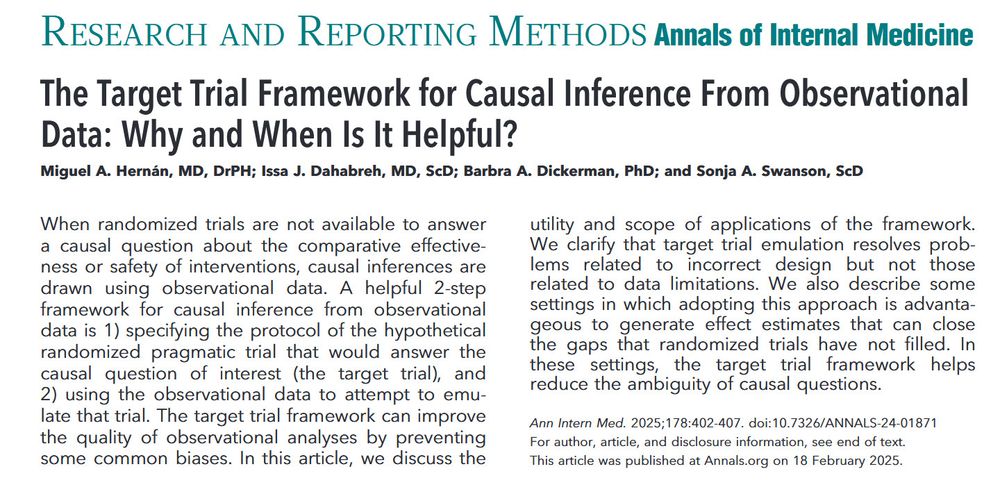
1/ When using observational data for #causalinference, emulating a target trial helps solve some problems... but not all problems.
In a new paper, we explain why and when the #TargetTrial framework is helpful.
www.acpjournals.org/doi/10.7326/...
Joint work with my colleagues @causalab.bsky.social
18.02.2025 13:08
👍 47
🔁 12
💬 3
📌 0
3. "Why use methods that require proportional hazards?"
@amjepi.bsky.social 2025
doi.org/10.1093/aje/...
The proportional hazards assumption is generally superfluous. We encourage the use of survival analysis methods that produce absolute risks and that don't require constant hazard ratios.
03.02.2025 14:51
👍 15
🔁 3
💬 1
📌 0
2. "Why test for proportional hazards?"
@jama.com 2020
jamanetwork.com/journals/jam...
Several examples show that hazards aren't expected to be proportional because either the effect isn't constant or the selection bias isn't constant.
An exception: null effect of treatment (hazard ratio=1)
...
03.02.2025 14:51
👍 3
🔁 0
💬 1
📌 0
1. "The hazards of hazard ratios"
EPIDEMIOLOGY 2010
journals.lww.com/epidem/fullt...
Hazard ratios have a built-in selection bias because of depletion of susceptibles. Also, reporting only hazard ratios is insufficient because we also need (adjusted) absolute risks for sound decision making.
...
03.02.2025 14:51
👍 2
🔁 0
💬 1
📌 0
In a recent commentary, Mats Stensrud and I argue that the proportional hazards assumption is not only implausible but also unnecessary.
doi.org/10.1093/aje/...
Easy-to-implement survival analysis methods that don't rely on proportional hazards are typically preferred.
The argument in 3 steps 👇
03.02.2025 14:51
👍 6
🔁 0
💬 1
📌 1
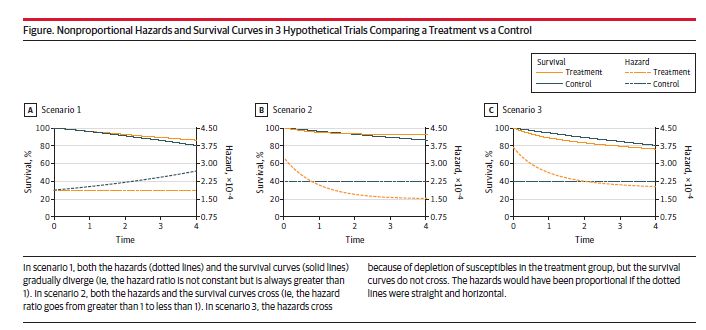
1/
If you were taught to test for proportional hazards, talk to your teacher.
The proportional hazards assumption is implausible in most #randomized and #observational studies because the hazard ratios aren't expected to be constant during the follow-up. So "testing" is futile.
But there is more 👇
03.02.2025 14:51
👍 79
🔁 20
💬 4
📌 1

2/
Immortal time may occur when individuals
1) are assigned to treatment strategies based on post-eligibility information or
2) determined to be eligible based on post-assignment information.
#TargetTrial emulation prevents it by synchronizing eligibility and assignment at the start of follow-up.
06.01.2025 16:41
👍 7
🔁 0
💬 0
📌 1

1/
That "immortal time" is so frequent in survival analyses for #causalinference is fascinating.
Because "immortal time" doesn't exist in the data, *we* create it when misanalyzing the data.
Our new paper pubmed.ncbi.nlm.nih.gov/39494894/ summarizes why immortal time arises & how to prevent it.
06.01.2025 16:41
👍 51
🔁 18
💬 3
📌 0
Upgrade your #causalinference arsenal.
A revision of our book "Causal Inference: What If" is available at miguelhernan.org/whatifbook
Thanks to everyone who suggested improvements, reported typos, and proposed new citations and material.
Enjoy the #WhatIfBook plus code and data. Also, it's free.
23.12.2024 09:28
👍 370
🔁 113
💬 10
📌 7

Seven myths of randomisation in clinical trials - PubMed
I consider seven misunderstandings that may be encountered about the nature, purpose and properties of randomisation in clinical trials. Some concern the practical realities of clinical research on pa...
Agree. Stephen Senn's "Seven myths of randomisation in clinical trials" pubmed.ncbi.nlm.nih.gov/23255195/ is a good place to start.
And the work by Jamie Robins and colleagues helped us understand "the curse of dimensionality" in high-dimensional settings (references in Chapter 10 of "What If").
26.11.2024 13:56
👍 26
🔁 5
💬 0
📌 0
In Chapter 10 of "Causal Inference: What If", we describe arguments for adjustment in randomized trials and refute some fallacies used to advise against adjustment.
www.hsph.harvard.edu/miguel-herna...
A practical challenge is how to incorporate adjustment into the design of #randomizedtrials.
26.11.2024 13:38
👍 35
🔁 1
💬 2
📌 0
When risk factors are imbalanced for non-chance reasons in #observational studies, we call it #confounding.
An interesting point is that, regardless of whether the imbalance results from chance or confounding, we are better off ADJUSTING for prognostic factors that are imbalanced between groups.
26.11.2024 13:38
👍 33
🔁 1
💬 1
📌 2
Unsurprising. By definition, the 95% confidence interval of 5% of (perfect) trials isn't expected to include the true value of the effect.
Again: Of 20 randomized trials in which treatment truly has a null effect, the 95% CI of one of them isn't expected to include the null value. Just by chance.
26.11.2024 13:38
👍 18
🔁 1
💬 2
📌 0
Vass M (PhD Thesis). Prevention of functional decline in older people. Faculty of Health Sciences, U of Copenhagen 2010, p.120.
(Thanks to Mikkel Zöllner Ankarfeldt for bringing this example to my attention.)
What happened? By chance, some risk factors were more common in the intervention group.
26.11.2024 13:38
👍 14
🔁 0
💬 1
📌 0
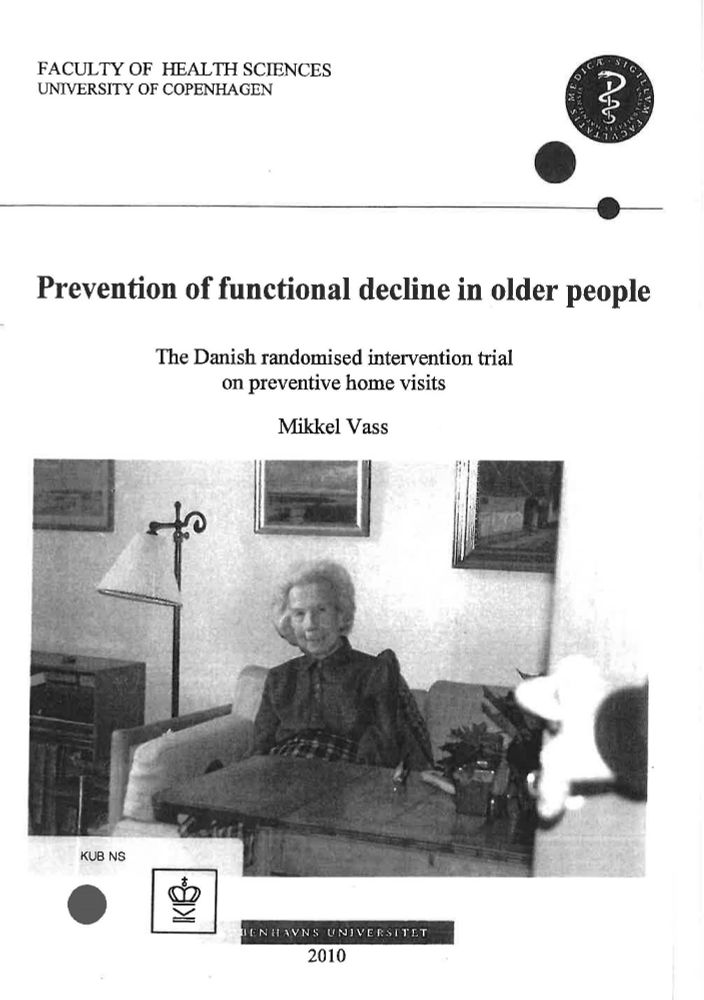
Does #randomization ensures balance of risk factors between groups? Consider this:
In Denmark 860 individuals were randomly allocated to either intervention or control. Individuals were unaware of their allocation. No intervention took place. Mortality was higher in the intervention group (p=0.003)
26.11.2024 13:38
👍 125
🔁 47
💬 7
📌 6

Alberto Brandolini presents a slide with the text "The amount of energy necessary to refute bullshit is an order of magnitude bigger than to produce it"
It's always a good time to remember Brandolini's principle
@ziobrando.bsky.social
20.11.2024 17:34
👍 72
🔁 17
💬 4
📌 1