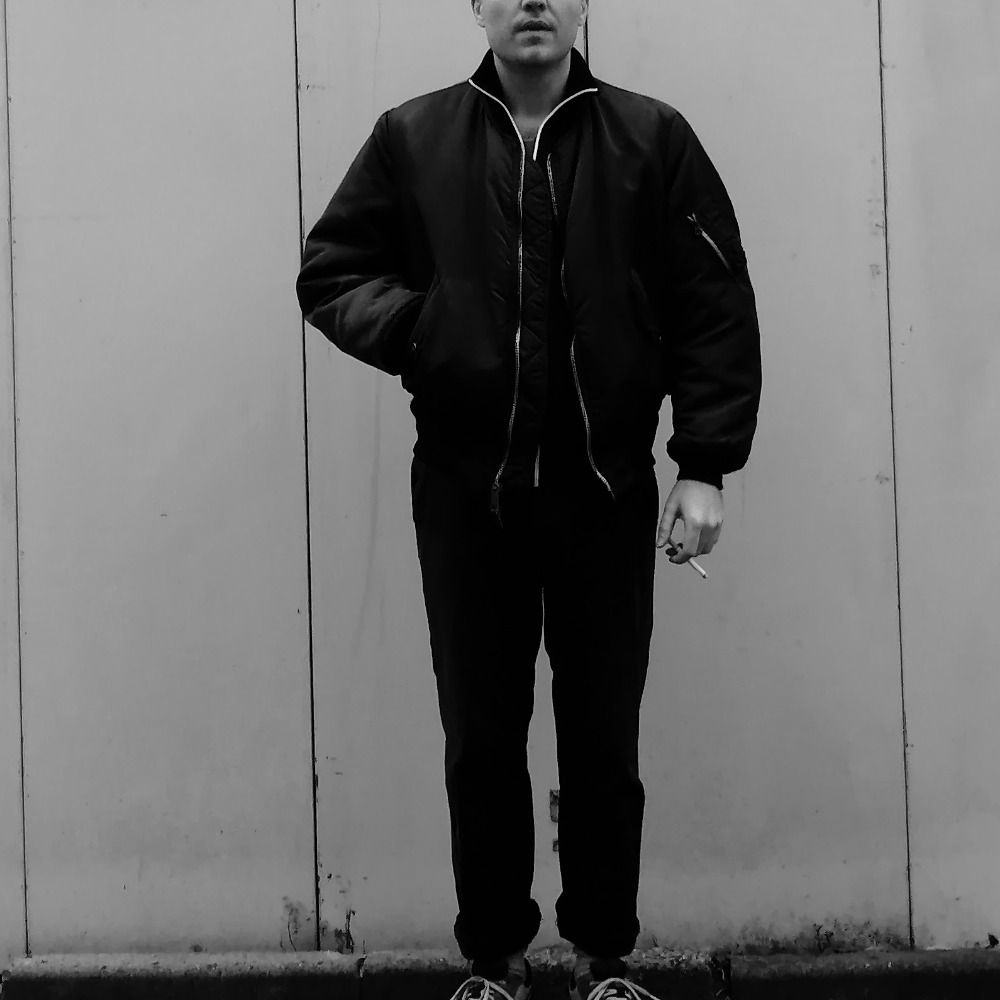


Negishi, Kamiyacho. January, 2026.
23.01.2026 08:43
👍 2
🔁 0
💬 0
📌 0
Negishi, Kamiyacho. January, 2026.


On the receding shores of Central Asia's Aral Sea, a Chinese man known as "the King" lives alone in a tent, digging for shrimp eggs. By Liu Zichao, a bold new voice in travel writing, translated by
@dylanleviking.bsky.social
www.equator.org/articles/kin...


I will send more pictures of life on the Hibiya Line.


I hate the way that high-quality black-and-white film looks. There's something off-puttingly sharp about it. It doesn't resemble the way that I see the world. My eyes must be getting worse. I want haze and blocks of color.


She is going to read Yuk Hui's article on technodiversity in CONG (and she has already read my contribution, which is about going out in Guangzhou). This is promotion for a magazine that I'm not sure anybody but its contributors and publishers have read.

This is an old picture. Provia 400X isn't made anymore. A pack of five rolls of slide film in 120 would be more than a hundred bucks. I used to not think much about the price. I had no clear approach to selecting film stock. I lost all of the pictures, anyway.


A note on a bookstore shutter in Jinbocho: "To an unknown Frenchman..."

3. "Eastern Promises," @dylanleviking.bsky.social @thebafflermag.com
"Reading a delightful essay on clutter in Japan made me realize how I’d held a romanticized version of Tokyo in my head for 20 years. Dylan Levi King’s Baffler piece challenges me in a similar way."
thebaffler.com/salvos/easte...
Someone should at least turn Barthes to enka, if they haven't before. It's beyond me. I had never read this essay before today. I am too late. It must have been done before and more thoroughly.
I have watched this a hundred times. I have watched it a thousand. I wrote about it in an essay on Miyako Harumi. But language fails. Adjectives fail. That is what Barthes says. We are left with "the impossible account of an individual thrill."


I could never explain precisely what I love about the 1966 performance of the song. I appreciate that her growl is clearly not from rokyoku but borrowed through Hirota Mieko from American R&B records. I appreciate the adolescent flirtation in the performance, incongruous with a song of parting.
I have still never heard Charles Panzéra and Dietrich Fischer-Dieskau, so I would like to rewrite "The Grain of the Voice" about the Miyako Harumi singing "Anko tsubaki wa koi no hana" on Furusato no uta matsuri in 1966 and Miyako Harumi singing a duet on the same song with Ishikawa Sayuri in 1971.
I think this is the right way to explain the situation: it will be published by Guizhou University Press but is a production of Yuefu Culture. I think an English translation is unlikely.


(I do not write like Jia Pingwa or Zhang Chengzhi, but from the process of translating their work, I have learned a certain amount about how to structure a novel, and how much dedication is required to write one.)
The author—Hu Lingyun—has translated J.G. Ballard and Thomas Pynchon. (I am not imagining that the novel resembles in any way their work. The work of translation is instructive, though, I hope. It is like tearing apart a clock or a camera—some mechanical thing—and putting it back together.)

Since I learned about it a few years ago, I have wanted to read 803. It was described as a Proustian memoir of Third Front industrialization and its aftermath in Guizhou, narrating decades in a monologue sustained across eight hundred pages. It will come out this year.
I would like to write about the enjoyment I felt standing at the kitchen counter this morning, fishing with a set of long kitchen chopsticks the desiccated chicken skin, gristly meat, and brittle, black bones out of my jar of Lao Ganma Chicken Oil Chili. I can turn this into something productive.

November, 2022.

November, 2022.

November, 2022. (I can see the Skytree from north of Ueno Park.)
I am comforted sometimes by the thought of the contents of the internet being slowly deleted. I always hoped that certain confessions could disappear. It's not that I am ashamed but that I would like to make them again, in a more artful way. Well. But it's still a terrible thing to contemplate.
Later, I noticed for the first time that the temple hosts an annex that teaches classes in yoga, meditation, and energy healing. I thought of my neighbor, who opened up to me about her vaccine skepticism. It seemed to be the product of the same neuroses that led her before to veganism and crystals.
I could not understand those activists that stormed buildings temporarily hosting vaccination clinics. I still think that they must have been, like many radicals in this country, caught in the wash of American social media. They disappeared. The bulletin board was up-to-date.
I thought the information must be outdated, from the time three years ago when there was a drive to have everyone vaccinated, and we all received invitations in the mail. Unlike other places around the world, there was lax enforcement of the vaccine mandate. Skeptics were not under pressure.

