

There’s plenty more in the paper (incl. litany of robustness checks)
Please take a look! www.imf.org/en/Publicati...
09.07.2025 12:37
👍 0
🔁 0
💬 0
📌 0
There’s plenty more in the paper (incl. litany of robustness checks)
Please take a look! www.imf.org/en/Publicati...

Bonus: IV estimation of the Taylor rule works very well. Reliable, robust.
If you are interested in this method, you can find the macro shocks we use here: github.com/jonathanjada...
Application #2: We estimate the macro effects of synthetic MPS.
- The synthetic surprise is contractionary, but has no effect on prices.
- Instead, deflationary effects of (some) EMPS are due to their long-run news components.
Unwelcome news if you wanted to use EMPS to study textbook policy surprises?
Fortunately, we offer a way to do that (and more!) Using our method, it is possible to construct a *synthetic* monetary policy shock approximating any desired term structure of policy news!

Finding: *all shocks* are mostly news.
Even the most surprise-like shocks are <50% due to immediate policy changes. Here’s the Aruoba-Drechsel narrative shock:

Application #1: We estimate the term structures of popular EMPS in the literature.
E.g. here is the term structure for Swanson’s forward guidance shock. Nearly all the information is news about future policy.
This is an unbiased estimator of the term structure! We also derive a smooth-local-projection variant.
Convenient: both can be written as a single-stage estimator with analytical standard errors (no bootstrap!)
Estimation has 4 stages:
1. Instrument for endogenous variables using macro IVs (Barnichon-Mesters)
2. Estimate policy rule by IV
3. Whiten the policy residual to find the innovation
4. Regress on past EMPS (local projection)
The coefficients from the final stage = term structure
So, if we want to use EMPS to evaluate our theories, we absolutely need to know how they depend on surprise vs news over many horizons. We call this the *Term Structure of Monetary Policy News*.
Fortunately: there is a way to estimate this term structure!

Important: surprise shocks have different effects from news shocks at every news horizon.
Here’s how they affect prices in the New Keynesian model:
Background:
EMPS are used to evaluate our theories of monetary policy. But this cannot really be done without knowing what the EMPS *are*.
EMPS are not just textbook target rate surprises. They also contain “news shocks” about future policy.
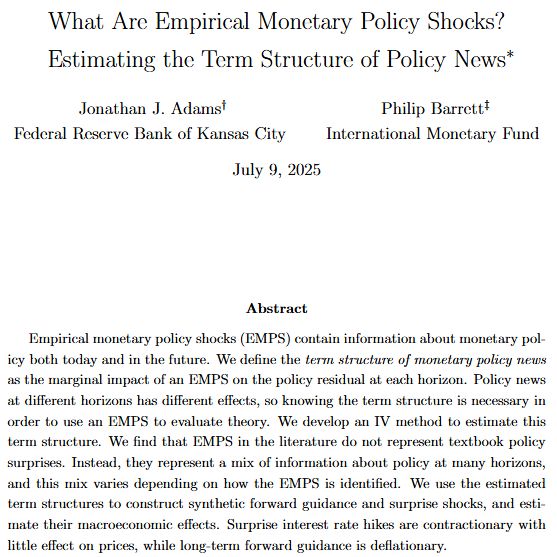
Philip Barrett @phibar.bsky.social and I address this question in a new working paper.
In it, we propose a method to extract the news that EMPS contain about future policy, and apply the method to many shocks from the literature. There is a lot to learn!

🧵:
What does monetary policy do?
Our best evidence comes from quality empirical monetary policy shocks (EMPS) using high-frequency and narrative methods.
… but what *are* these shocks?
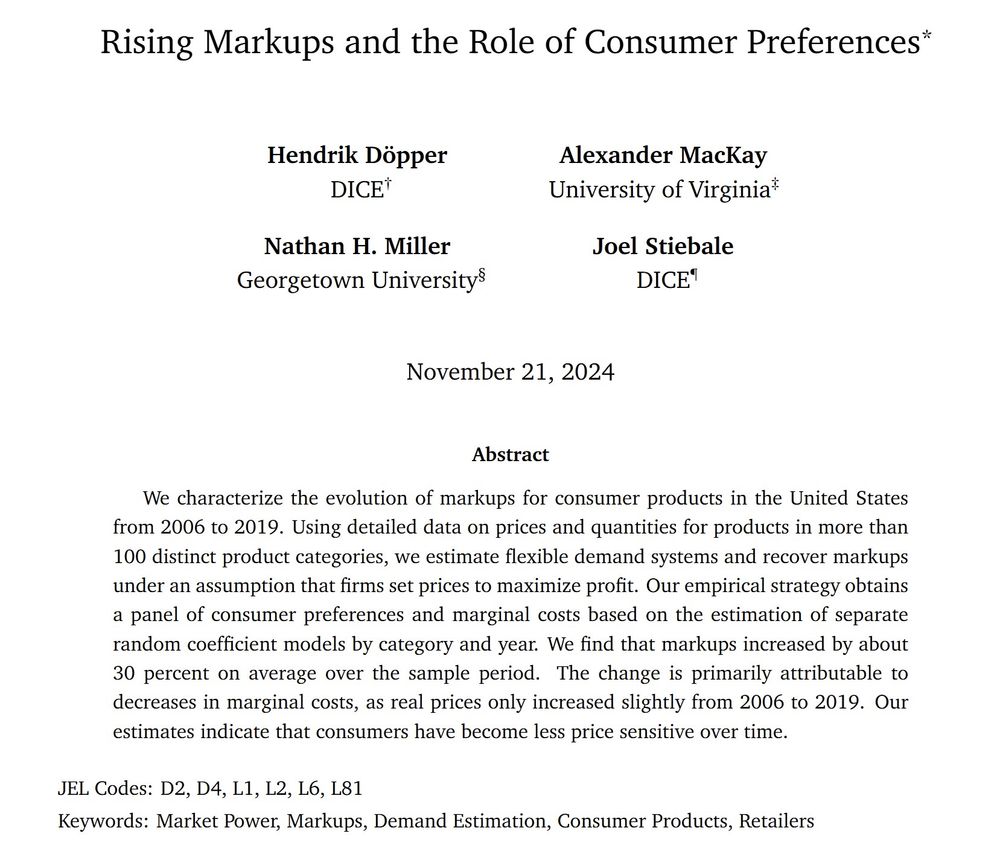
Forthcoming at the Journal of Political Economy: We find that consumer product markups increased more than 25 percent from 2006 to 2019.
One contribution is an approach to estimate IO-style models at scale, yielding flexible consumer preferences and estimates of marginal costs.
Done!
Hi Isaac! Done.

JPE logo
A new paper from the Journal of Political Economy investigates how PhD program ranking, department status, and other author connections impact peer review decisions. Read the full findings here: ow.ly/sfLx50UiGII #EconSky
Frankly, I think it *is* preferable to have all the proof details spelled out in an appendix.
This will lead to some long appendices, of course. It is a problem that some journals punish this by requiring that page limits include proofs. That's a mistake. We don't require page limits for code!
I would guess one of the core reasons for this is the heterogeneity in math knowledge among economists, even in theory literatures. As a result:
1. Readers cannot be trusted to fill in the gaps
2. Readers may not trust the writer to do so
Econ editors and referees push both of these points.
Macroeconomists of #econsky what are some published examples of macro models featuring all of:
1. Information frictions
2. Endogenous signals (i.e. some signals contain information about equilibrium aggregates)
3. **All** signals include idiosyncratic shocks (e.g. noise)
Any ideas?

Some of the most important lottery anomalies from the behavioral risk literature (e.g., probability weighting and loss aversion) actually have nothing to do with risk.
They also arise in perfectly deterministic settings.
Lead article in the latest AER issue:
www.aeaweb.org/articles?id=...
AI pricing is on the rise!
Every year, more firms use the technology (broadly defined); those that do are larger and earn higher markups.
Done and done.
Is that because the department has to pay the tuition expense to the university? Or other costs?
Done.
Hi Auguste, welcome. The list is narrowly defined: academic researchers actively publishing in macroeconomics. My impression is that this does not apply to you, but if I am wrong, please send let me know.
Hi Daniel! You bet.
Done.
Done.