I recently got the chance to speak with radiology residents @umasschan.bsky.social about AI's impact on their field
This slide particularly resonated: a familiar pattern they've seen with AI assistive tools is having to nudge MDs to trust them *less*
24.02.2026 14:00
👍 2
🔁 0
💬 1
📌 0

Looking at workers in industrial jobs exposed to automation, those who worked with robots directly were more likely to believe both that (a) their job was automatable and (b) robots would create new job opportunities for them.
12.02.2026 12:00
👍 0
🔁 0
💬 0
📌 0

College students would need to be paid $59 (on average) to deactivate TikTok for a month, but would *pay* $28 for it to be deactivated for them and their social circles for the same amount of time.
11.02.2026 18:00
👍 4
🔁 0
💬 1
📌 0

AI in Africa: Barriers, opportunities and policy
Can AI take off in Africa? Rose Mutiso joins us to discuss the need for an energy and digital infrastructure revolution on the continent, and how to make it happen.
AI is often framed as Africa’s next leapfrog.
In Ep2 of our @voxdev.bsky.social series, Rose Mutiso argues this is the wrong frame: AI isn’t end-user tech like mobile phones, but an upstream, infrastructure-heavy system that concentrates value where power, compute, and data already exist.
10.02.2026 17:01
👍 3
🔁 2
💬 0
📌 0

AI and the industrial revolution: Similarities, differences and lessons
How did society change during the industrial revolution? Are there lessons we can learn for the AI revolution?
People invoke the Industrial Revolution as reassurance about AI. But living through it meant decades of wage stagnation, job loss & unrest.
Ep1 of a new @voxdev.bsky.social series, we talk to economic historian Bruno Caprettini about what that analogy gets right/wrong
t.co/AyuTVMKcEY
06.02.2026 22:59
👍 4
🔁 3
💬 0
📌 0

The “AI bubble” may be less catastrophic than it sounds. Even if it pops, it’s leaving behind real infrastructure, much like past bubbles did. My take for @TheMorningNews.org 2025 year-in-review post:
06.01.2026 13:30
👍 3
🔁 0
💬 0
📌 0

And I thought this was pretty interesting from @deenamousa.com
02.01.2026 20:36
👍 1
🔁 1
💬 1
📌 0

New post: ML trained on phone usage data can help identify households in need during crises.
Not yet finalized your end of year giving? I've teamed up with GiveDirectly along with a few other Substackers, and I’ll be matching the first $500 in donations through the link in post.
22.12.2025 02:19
👍 4
🔁 0
💬 1
📌 0
PainChek Adult was offered de novo FDA clearance this week, and engineers are now adapting the code for the very youngest patients. PainChek Infant targets babies under one year, whose grimaces flicker faster.
15.10.2025 17:49
👍 0
🔁 0
💬 1
📌 0
Data shows a ~25% drop in antipsychotic use and, in Scotland, a 42% reduction in falls from use. One clinician mentioned that residents who had skipped meals because of undetected dental pain began eating again, and those who were isolated due to pain began socializing.
15.10.2025 17:49
👍 0
🔁 0
💬 1
📌 0
Linking the scan to a human‑filled checklist was, they admit, a late design choice. Initially, they thought AI should automate everything but found that hybrid use yielded better results...
15.10.2025 17:49
👍 0
🔁 0
💬 1
📌 0

There are several devices in clinical use today, like PainChek, a smartphone app that scans the facial expressions of people who have dementia and uses AI to output an expected pain score to inform their care.
They also record data for the patient and facility over time.
15.10.2025 17:49
👍 0
🔁 0
💬 1
📌 0

Just out in @technologyreview.com: I look at the companies using AI to measure how much pain patients are in based on everything from involuntary facial movements, to heart rate, to peripheral temperature changes.
Will this oust the classic self-reported 1-10 scale?
15.10.2025 17:49
👍 1
🔁 0
💬 2
📌 0
Full paper: www.thelancet.com/journals/la...
15.10.2025 13:34
👍 0
🔁 0
💬 0
📌 0

A new paper in the Lancet finds that doctors got *worse* at finding precancerous growths during colonoscopies on their own if they had just spent three months using an AI assistive tool
Worrisome sign that deskilling may happen a lot faster than we'd expect.
15.10.2025 13:34
👍 8
🔁 2
💬 2
📌 0
Data from www.jpain.org/article/S15...
15.10.2025 04:00
👍 0
🔁 0
💬 0
📌 0

We also don't fully understand why many people experience phantom limb pain, and many others don't
x.com/deenamousa/...
15.10.2025 04:00
👍 5
🔁 0
💬 1
📌 0
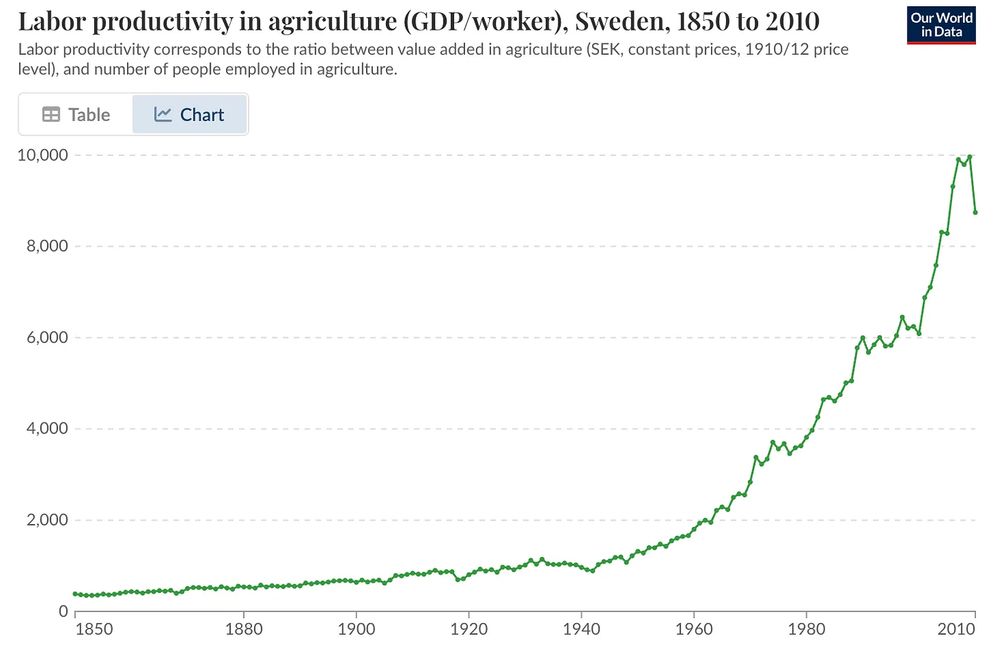
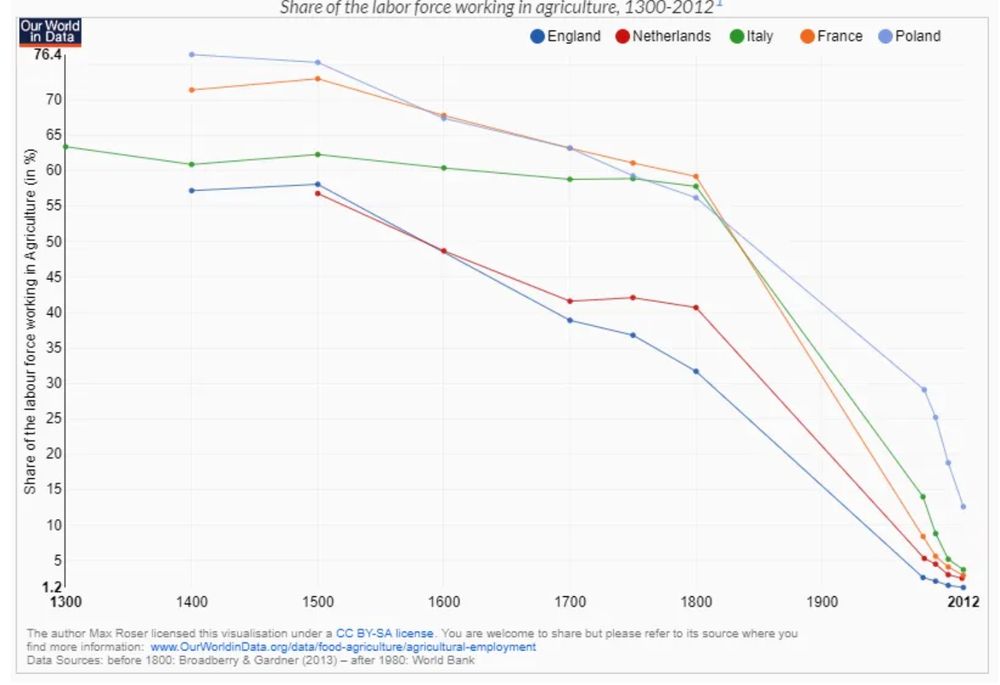
There are exceptions to this rule, though; the rise in mobile banking eventually did reduce bank teller employment. If the technology fully replaces human inputs, or drives efficiency gains so large they outpace the increase in demand, jobs will be lost.
07.10.2025 14:13
👍 0
🔁 0
💬 1
📌 0
In each of these cases, employment holds steady, but the skill mix changes. The work gets more complex as machines take over the simplest tasks.
07.10.2025 14:13
👍 0
🔁 0
💬 1
📌 0
This can happen in other fields too — for example, spreadsheets didn't get rid of accountants, but rather made them more in demand than before. In law, predictive coding and e-discovery tools reduce grunt work but let firms take on more complex cases.
07.10.2025 14:13
👍 0
🔁 0
💬 1
📌 0
This is an example of Jevons paradox: when tech makes something cheaper or more efficient to use, we'd expect to use less of it and achieve the same result. But in some cases, people use *more* of the good because it's more accessible.
07.10.2025 14:13
👍 0
🔁 0
💬 1
📌 0

When ATMs spread across the U.S., you'd expect bank tellers to be laid off en masse. But teller employment actually rose during the 2000s, growing 2% annually.
By reducing the cost of operating bank branches, ATMs made it possible for banks to open more locations.
07.10.2025 14:13
👍 0
🔁 0
💬 1
📌 0
New post: When can more automation mean more human workers?
One argument I made in my recent @worksinprogress.bsky.social piece is that if automation made reading scans quicker and cheaper, this might result in *more* jobs for radiologists, rather than fewer.
How does this apply to other jobs? 🧵
07.10.2025 14:13
👍 3
🔁 2
💬 1
📌 0

The algorithm will see you now - Works in Progress Magazine
Radiology combines digital images, clear benchmarks, and repeatable tasks. But replacing humans with AI is harder than it seems.
AI radiology today is powerful, but it consists of many narrow islands of automation that have failed to replace radiologists' time.
This isn't the full picture. Read more in the @worksinprogress.bsky.social piece: worksinprogress.co/issue/the-a...
25.09.2025 13:53
👍 28
🔁 5
💬 3
📌 1
On top of this, datasets are still a barrier for some scans and patient populations. Even with 700+ FDA-approved imaging AIs, they cover only a fraction of real-world work; most cluster around a few conditions like stroke, breast cancer, or lung cancer.
25.09.2025 13:53
👍 25
🔁 0
💬 1
📌 1