
📢 PhD position in the NeuroAI of Language
Why can LLMs predict brain activity so well? We're hiring a PhD student to find out -- AI interpretability meets neuroimaging
Deadline March 20
Please RT 🙏
👇
mpi.nl/career-education/vacancies/vacancy/fully-funded-4-year-phd-position-neuroai-language
05.03.2026 13:34
👍 45
🔁 35
💬 2
📌 1
I did a MSc project on seal pup vocalization timing in long rehab centre recordings years ago, may still have some relevant refs scripties.uba.uva.nl/search?id=re... and I believe Koen de Reus' PhD thesis (to be defended this week) has a bunch more up-to-date work on this! www.mpi.nl/events/imprs...
18.02.2026 10:11
👍 3
🔁 0
💬 1
📌 0
Our paper has been accepted to EACL 2026!🎉 We systematically evaluate several vision-language (VLMs) and language-only models, measuring their alignment with brain responses to concept words. Our results show that vision-language models offer a promising tool to model human concept processing
23.01.2026 12:02
👍 14
🔁 4
💬 1
📌 0

Thrilled to announce the 1st Workshop on Computational Developmental Linguistics (CDL) at ACL 2026 🎉 A new venue at the intersection of development linguistics × modern NLP, spearheaded by @fredashi.bsky.social @marstin.bsky.social, and and outstanding team of colleagues!
A thread 🧵
20.01.2026 11:26
👍 22
🔁 9
💬 3
📌 1

Commentary title:
Linguists should learn to love speech-based deep learning models
Authors:
Marianne de Heer Kloots, Paul Boersma, Willem Zuidema
Abstract:
Futrell and Mahowald present a useful framework bridging technology-oriented deep learning systems and explanation-oriented linguistic theories. Unfortunately, the target article's focus on generative text-based LLMs fundamentally limits fruitful interactions with linguistics, as many interesting questions on human language fall outside what is captured by written text. We argue that audio-based deep learning models can and should play a crucial role.
'Tis the season to preprint BBS commentaries; I'm happy to share ours too! 🎄✨
The textual basis of current LLMs causes trouble, but linguistically relevant insights *can* be found in systems modelling the more natural form of human spoken language: the speech signal itself. arxiv.org/abs/2512.14506
17.12.2025 15:21
👍 27
🔁 10
💬 1
📌 1
New book! I have written a book, called Syntax: A cognitive approach, published by MIT Press.
This is open access; MIT Press will post a link soon, but until then, the book is available on my website:
tedlab.mit.edu/tedlab_websi...
24.12.2025 19:55
👍 122
🔁 41
💬 2
📌 3

How cognitive science can contribute to AI: methods for understanding
#2 in a series on cognitive science and AI
New post! Last week I shared why I thought cognitive (neuro)science hasn’t contributed as much as one might hope to the design of AI systems; this week I'm sharing my thoughts on how methods and principles from these fields *have* been useful in my work. infinitefaculty.substack.com/p/how-cognit...
23.12.2025 17:09
👍 42
🔁 8
💬 2
📌 3

Poster title: Does multimodal pre-activation influence linguistic expectations in LLMs and humans?
Authors: Sasha Kenjeeva, Giovanni Cassani, Noortje Venhuizen, Afra Alishahi

Poster title: Generalizing Without Evidence: How Transformer Models Infer Syntactic Rules From Sparse Input
Authors: Mark van den Hoorn, Raquel G. Alhama

Poster title: Dependency Length, Syntactic Complexity & Memory: A Reading Time Benchmark for Sentence Processing Modeling
Authors: Nina Nusbaumer, Corentin Bel, Iria de-Dios-Flores, Guillaume Wisniewski, Benoit Crabbé

Poster title:
The success of Neural Language Models on syntactic island effects is not universal: strong wh-island sensitivity in English but not in Dutch
Authors: Michelle Suijkerbuijk, Naomi Tachikawa Shapiro, Peter de Swart, Stefan L. Frank
Cool posters from day 2!
@sashakenjeeva.bsky.social openreview.net/forum?id=Vtd...
github.com/markvandenho... openreview.net/forum?id=rX3...
@nina-nusbaumer.bsky.social openreview.net/forum?id=GRz...
www.ru.nl/personen/sui... openreview.net/forum?id=NcJ...
19.12.2025 16:03
👍 4
🔁 1
💬 1
📌 1


Today we are time-travelling with @stefanfrank.bsky.social 😎
19.12.2025 12:18
👍 2
🔁 0
💬 1
📌 0
This is in response to the recent target article by @futrell.bsky.social & @kmahowald.bsky.social, a wonderful read! Thanks to the authors for writing such a clear and inspiring piece to start this discussion. doi.org/10.1017/S014...
17.12.2025 15:21
👍 1
🔁 0
💬 0
📌 0
Commentary title:
Linguists should learn to love speech-based deep learning models
Authors:
Marianne de Heer Kloots, Paul Boersma, Willem Zuidema
Abstract:
Futrell and Mahowald present a useful framework bridging technology-oriented deep learning systems and explanation-oriented linguistic theories. Unfortunately, the target article's focus on generative text-based LLMs fundamentally limits fruitful interactions with linguistics, as many interesting questions on human language fall outside what is captured by written text. We argue that audio-based deep learning models can and should play a crucial role.
'Tis the season to preprint BBS commentaries; I'm happy to share ours too! 🎄✨
The textual basis of current LLMs causes trouble, but linguistically relevant insights *can* be found in systems modelling the more natural form of human spoken language: the speech signal itself. arxiv.org/abs/2512.14506
17.12.2025 15:21
👍 27
🔁 10
💬 1
📌 1

Why Do Humans Have Linguistic Intuition?
| Cadernos de Linguística
Why do humans have linguistic intuition? And why should you care?
A short thread about my new paper in @cadlin.bsky.social
This work has the most original insight I've ever had, a genuinely new idea about the nature of language
cadernos.abralin.org/index.php/ca...
1/20
15.12.2025 16:14
👍 57
🔁 20
💬 3
📌 1
What’s Surprising About Surprisal - Computational Brain & Behavior
In the computational and experimental psycholinguistic literature, the mechanisms behind syntactic structure building (e.g., combining words into phrases and sentences) are the subject of considerable...
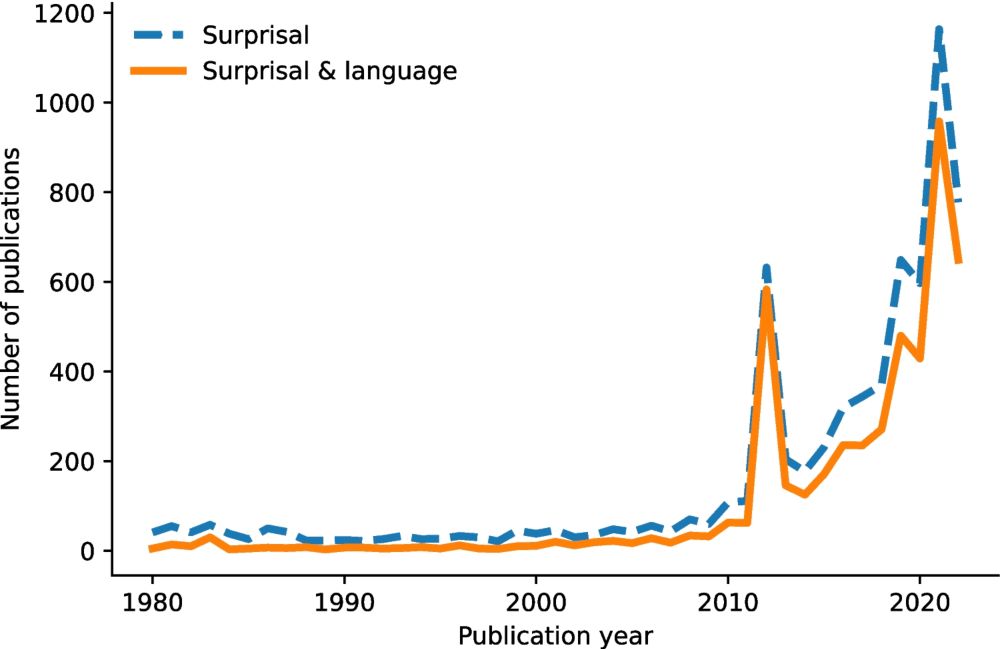
Many studies of naturalistic comprehension report that surprisal (often LLM derived) explains more of the variance in data than other predictors. Why is this? And why can it be problematic for our conclusions?
A 🧵 of takeaways from our paper doi.org/10.1007/s421... with @andreaeyleen.bsky.social
17.11.2025 17:12
👍 23
🔁 8
💬 1
📌 1

Why isn’t modern AI built around principles from cognitive science?
First post in a series on cognitive science and AI
Why isn’t modern AI built around principles from cognitive science or neuroscience? Starting a substack (infinitefaculty.substack.com/p/why-isnt-m...) by writing down my thoughts on that question: as part of a first series of posts giving my current thoughts on the relation between these fields. 1/3
16.12.2025 15:40
👍 117
🔁 34
💬 4
📌 5
I had a wonderful time getting to know @gronlp.bsky.social last week while discussing linguistic structure and learning trajectories in speech models! ✨ Many thanks for the invite @frap98.bsky.social, already looking forward to catching up again soon :)
01.12.2025 17:13
👍 13
🔁 0
💬 0
📌 0

The title page
🚨NEW PUBLICATION ALERT!🚨
The 'Design Features' of Language Revisited (w/ @mperlman.bsky.social @glupyan.bsky.social Koen de Reus & @limorraviv.bsky.social)
Feature Review out now in #OpenAccess in @cp-trendscognsci.bsky.social! #language #linguistics
Paper: doi.org/10.1016/j.ti...
25.11.2025 19:48
👍 102
🔁 32
💬 3
📌 2
Interested in the evolution of human language? Check out our new paper in @science.org where we synthesize latest findings and outline a multifaceted, bio-cultural approach for studying how language evolved. Super proud of this work, and hoping it leads to exciting new research! tinyurl.com/ykacvanp
21.11.2025 09:47
👍 41
🔁 15
💬 2
📌 1
The Multilingual Minds & Machines Meetings call for abstracts is now open! Everything you need to know is here -> mmmm2026.github.io
18.11.2025 10:05
👍 10
🔁 7
💬 0
📌 1

Human cortical dynamics of auditory word form encoding
We perceive continuous speech as a series of discrete words, despite the lack of clear acoustic boundaries. The superior temporal gyrus (STG) encodes …
happy to share our new paper, out now in Neuron! led by the incredible Yizhen Zhang, we explore how the brain segments continuous speech into word-forms and uses adaptive dynamics to code for relative time - www.sciencedirect.com/science/arti...
07.11.2025 18:16
👍 48
🔁 17
💬 2
📌 1
PNAS
Proceedings of the National Academy of Sciences (PNAS), a peer reviewed journal of the National Academy of Sciences (NAS) - an authoritative source of high-impact, original research that broadly spans...
Delighted to share our new paper, now out in PNAS! www.pnas.org/doi/10.1073/...
"Hierarchical dynamic coding coordinates speech comprehension in the brain"
with dream team @alecmarantz.bsky.social, @davidpoeppel.bsky.social, @jeanremiking.bsky.social
Summary 👇
1/8
22.10.2025 05:21
👍 93
🔁 35
💬 2
📌 5

🌍Introducing BabyBabelLM: A Multilingual Benchmark of Developmentally Plausible Training Data!
LLMs learn from vastly more data than humans ever experience. BabyLM challenges this paradigm by focusing on developmentally plausible data
We extend this effort to 45 new languages!
15.10.2025 10:53
👍 44
🔁 16
💬 1
📌 4

Learning without training: The implicit dynamics of in-context learning
One of the most striking features of Large Language Models (LLM) is their ability to learn in context. Namely at inference time an LLM is able to learn new patterns without any additional weight updat...
Interesting paper suggesting a mechanism for why in-context learning happens in LLMs.
They show that LLMs implicitly apply an internal low-rank weight update adjusted by the context. It’s cheap (due to the low-rank) but effective for adapting the model’s behavior.
#MLSky
arxiv.org/abs/2507.16003
06.10.2025 13:30
👍 59
🔁 19
💬 1
📌 5

PhD Position: Accented Speech Processing | Radboud University
Do you want to work as a PhD: Accented Speech Processing at the Faculty of Arts? Check our vacancy!
PhD Position: Accented Speech Processing - Apply now!
Come work with Mirjam Broersma, @davidpeeters.bsky.social, and me at the Centre for Language Studies, Radboud University in the Netherlands.
Application deadline: 19 October 2025
For more information, see
www.ru.nl/en/working-a...
02.10.2025 14:35
👍 26
🔁 31
💬 0
📌 0
Huge congrats to the envisionBOX team for the Open Science award nomination! 🎉
My tutorial on speech analysis tools in Python from the Unboxing Multimodality summer school (github.com/mdhk/unboxin...) is now also available at envisionbox.org
Thanks for the invitation & this great initiative! 👏
02.10.2025 17:18
👍 10
🔁 3
💬 0
📌 0
Thanks to all co-authors in the Dutch SSL training team @hmohebbi.bsky.social @cpouw.bsky.social @gaofeishen.com @wzuidema.bsky.social + Martijn Bentum
And to @itcooperativesurf.bsky.social (EINF-8324) for granting me the resources that enabled this project 👩💻✨
27.08.2025 14:31
👍 0
🔁 0
💬 0
📌 0
Check out the paper for more details:
📄 arxiv.org/abs/2506.00981
Or the model, dataset and code released alongside it:
🤗 huggingface.co/amsterdamNLP...
🗃️ zenodo.org/records/1554...
🔍 github.com/mdhk/SSL-NL-...
We hope these resources help further research on language-specificity in speech models!
27.08.2025 14:31
👍 2
🔁 0
💬 1
📌 0


