
I might even try example mapping too, but I will have to do some more reading and trials for that
25.01.2025 15:24
👍 1
🔁 0
💬 1
📌 0
I might even try example mapping too, but I will have to do some more reading and trials for that
Overall, I don't regret the workshop because it brought some good energies into the collaboration and also gave me, as a newcomer in the company, a ton of insight. And I will try to keep further workshops more focused on a single configuration, which hopefully will give us more in-depth timelines.
I decided to go with event storming because I didn’t have any experience with example mapping, and to be honest, from the description in the book, it was not obvious to me for how to apply it to my situation.
This meant that initially we were not able to even establish a timeline and instead had a big chaos on our hands, which we later drastically simplified, and then the simple timeline emerged
I wanted to give you some feedback for your very generous advice. You were of course completely right that the final storyline was indeed pretty simple, and the complexity was in different configurations and in the details.
I will check out Example Mapping
I still think there might be value to agree on the global storyline. Especially because we have Hardware, Firmware, Middleware, Data Science teams involved - so there might be misunderstandings.
Thanks for the input!
I was planning to use EventStorming but the argument for the "simplicity" of the story makes a lot of sense, events like "Measured trace delivered" are simple but how they come to be is not (physics and stuff).
Any chapters in your book you would recommend as preparation for a workshop of this kind?
@kenny.weave-it.org do you have experience with using collaborative modeling for embedded systems? I am looking for the right format to align a couple of teams from hardware to cloud but it is not a straightforward process, so Event approaches seem inadequate.
there is a certain comfort in formulaic development
"well, today I will do the entity classes, tomorrow the repository and after that the controller and service"
but if something is formulaic maybe it should not be done manual at all
What about a thin interface for unit testing?
the fastest horse in the feature factory
I have been informed that "data platform" means "chaining together data lakes and spark jobs" for many people
funny how you can skip all of pythons ecosystem when instead your platform only does ingest and retrieval (and absurdly complex non-numeric processes)
long-term I want to be working on developing infrastructure or other technically challenging topics, so I have finally bit the bullet and am learning Rust
it's crazy how much easier it is this time around now that writing high perf go has made me memory and pointer sensitive
I am wondering under which circumstances the uniqueness probability of UUIDs is not enough, defense tech?
nothing worse for my motivation than a project without urgency
either make it count for something or at least pretend and put us on some good old dev cycles
migrating a large scale streaming platform without downtime is quite difficult
I do not have the perfect arguments that a more collaborative way of working is more productive but I for sure know that I enjoy it more.
For sure the developers were already used to working in isolation, enhanced by massive month-long tickets and knowledge silos.
My tries of pulling people into calls for clarifications, reviews or design were met with question marks and resistance so I gave up.
assuming I am a nerd about architecture but also have the need for some practicality, how relevant is the course?
Only 30% of developers collaborate with colleagues on features, can that be true?
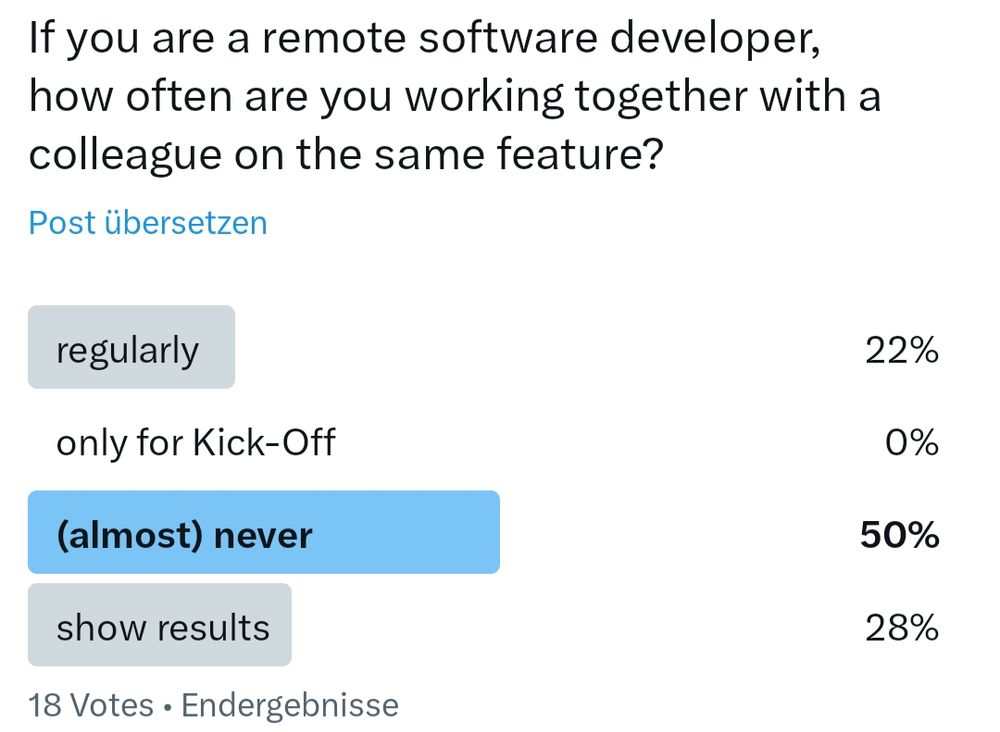
I did a little survey back in January with dismal results (maybe bad phrasing?)
Fascinating counter point is the Anthropic team which seems to pair program: x.com/lucca_dev/st...
My hypothesis is that in-person collab is often invisible which is why many of the people I questioned don't recognize it as such.
But I am honestly still confused if my expectations of actual pairing-style team-work are out snyc with most teams or if I haven't asked enough people.
I asked around and many people told me that their teams are also not collaborative in any synchronous way, which shocked me a little - I thought it was more common to do pairing on design and reviews and also to put multiple people on bigger topics.
My hypothesis is that no remote-friendly collab culture develops on its own when part of the team are working hybrid. My previous team was 95% remote.
My next team is mostly in-person but I am a little worried that no collab culture is present, which is one motivation for me to read your book.
I meant that management does not prohibit collab but also does not request it beyond some minimum.
When I started something felt off, so I made a spreadsheet. I counted a reduction of +70% in sync collab activities in contrast to my job before that.
The social aspects are fascinating.
I am in the process of leaving a company "just" for the lack of satisfying sync collab. I wasn't able to change the team culture enough via leading-by-example without any official authority, even though there was no barrier from above.
Curious if you have seen this workflow also in the wild, practiced on a regular basis?