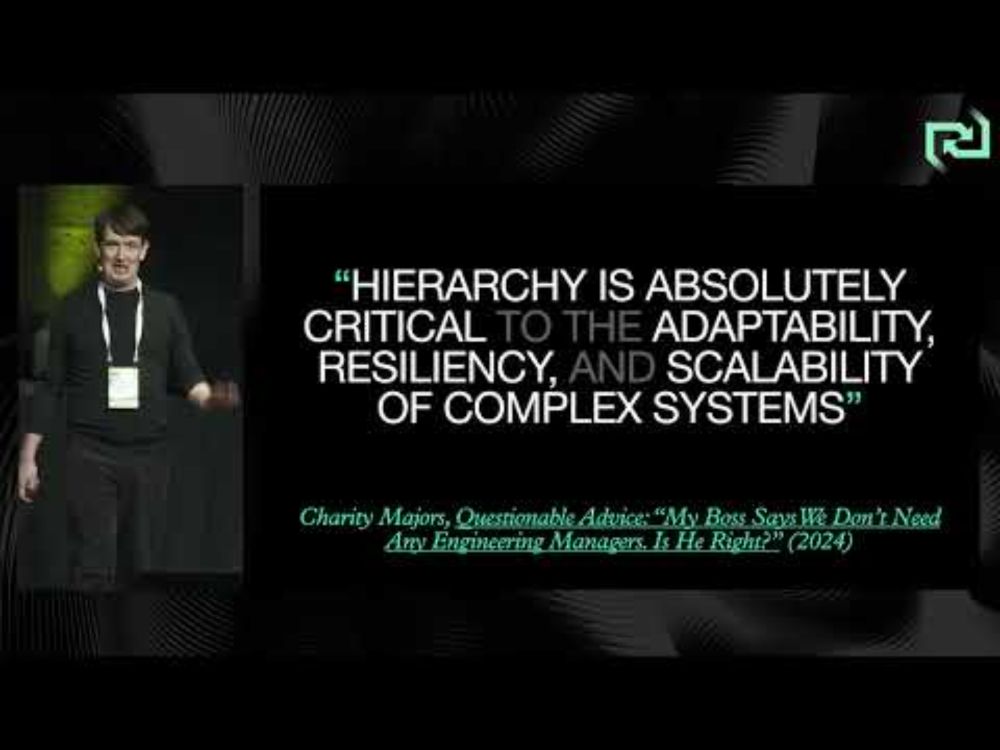
What you'll learn at AmA 2026
Next week. Final seats.
AI: @kevlin.bsky.social , Birgitta Boeckeler
Sociotechnical: @ewolff.com @settling-mud.bsky.social @tastapod.com
Decisions: @kenny.weave-it.org , @eoinwoods.bsky.social
pretix.eu/AmA/2026/
06.03.2026 11:48
👍 5
🔁 6
💬 1
📌 0
I really enjoyed this conversation with Sam Newman and @simon.bvssh.com. Lots of insight 👇🏻
27.02.2026 13:28
👍 3
🔁 3
💬 0
📌 0
Meet the speakers at Agile meets Architecture 2026
March 10–11, Berlin
Aino Vonge Corry, @andrewhl.bsky.social , Beija Nigl, Birgitta Boeckeler, @tastapod.com , @esilva.net , @ewolff.com ,
@emilybache.com , @eoinwoods.bsky.social
Join them: www.agile-meets-architecture.com
27.02.2026 11:58
👍 6
🔁 6
💬 1
📌 1
SW Design, Architecture & Clarity at Scale • Sam Newman, Jacqui Read & Simon Rohrer • GOTO 2025
This conversation was recorded at GOTO Copenhagen 2025. #GOTOcon #GOTOcph
https://gotocph.com
Sam Newman - Author of Building Microservices & Monolith to Microservices @samnewman4355
Jacqui Read -…
Design, architecture, and clarity at scale.
Sam Newman, @tekiegirl.bsky.social & @simon.bvssh.com on what it takes to build systems that scale.
GOTO Live Stage
21.01.2026 13:02
👍 1
🔁 1
💬 0
📌 1

Top 10 most-watched talks from AmA: @simonbrown.je , @kevlin.bsky.social , @simon.bvssh.com & more. Hard-won lessons from practitioners. Watch: www.youtube.com/playlist?lis...
22.12.2025 08:16
👍 1
🔁 2
💬 0
📌 0


@simon.bvssh.com: Continuous delivery in regulated industries (yes, it's possible)
Real organizations. Real constraints. Real solutions.
Save your spot for Agile meets Architecture 2026. Early bird tickets available www.agile-meets-architecture.com/2026/home
08.12.2025 12:20
👍 0
🔁 1
💬 0
📌 0
Simon Rohrer - 4 Lenses on Organisations
YouTube video by Agile meets Architecture
. @simon.bvssh.com 's "4 Lenses on Organizations" recording is now live! Watch as he masterfully connects socio-technical frameworks with organizational agility to drive effective change. Check out the full session and subscribe to our channel for more architecture wisdom!
youtu.be/fhhrLxBH-Ws
10.05.2025 12:31
👍 5
🔁 1
💬 0
📌 0
It’s not precise to say:
“If you cannot deal with monolith, microservices won’t work for you!”.
The actual phrase should be:
"If you can’t deal with modularity, then neither monoliths nor microservices will work for you."
3/
14.04.2025 06:54
👍 14
🔁 3
💬 1
📌 0
Just quoting Liz K :)
03.04.2025 21:01
👍 1
🔁 0
💬 0
📌 0

4 Lenses on Organisations
We'll look at 4 different models of an organisation. 4 different lenses on how to organise efficiently and effectively to deliver value to different parties.
Learn from @simon.bvssh.com how Value Streams, BVSSH, VSM, and Liquid Organisation models offer complementary perspectives to balance agility and architecture. Explore a multi-model approach—buy your ticket! www.agile-meets-architecture.com/sessions/202...
17.03.2025 12:38
👍 2
🔁 1
💬 0
📌 0
Better Value Sooner Safer Happier • Simon Rohrer & Eduardo da Silva • GOTO 2025
This interview was recorded for the GOTO Book Club. #GOTOcon #GOTObookclubhttp://gotopia.tech/bookclubRead the full transcription of the interview here:https...
Discover key strategies for transformation with insights from Better Value, Sooner, Safer, Happier. @esilva.net & @simon.bvssh.com discuss shifting from outputs to outcomes & embracing improvement.
13.02.2025 13:09
👍 4
🔁 2
💬 0
📌 1
Happy to chat more (SSH Slack?) – we use the Backstage service catalog to locate components and their code and docs including ADRs. High level guidelines otherwise pretty much as above, detailed guidelines evolving (eg what C4 diagrams to use), what’s mandatory, what’s advised
28.01.2025 14:09
👍 0
🔁 0
💬 0
📌 0

Neutral Quality is too much to ask for, shitty software is the norm.
As a testing community, we have failed to make software better. And let me be clear, developers have also failed. We are in the same boat here. I firmly believe that most people working in software de...
We have failed as testers & developers to make software better. It's simply not up to us, and I think we should be honest towards ourselves about how little impact we have on quality.... read the post and make up your own mind.
You can also keep sniffing the copium if that's what you prefer.
14.01.2025 12:20
👍 19
🔁 10
💬 3
📌 1

Evolution vs Revolution
Invite over inflict.
Not one size fits all.
When all you have is a hammer, everything looks like a nail.
#BVSSH
15.01.2025 09:50
👍 0
🔁 1
💬 0
📌 0
We have a dual strategy of transient docs in Confluence and long-lived docs in Markdown displayable in Backstage. Lowest level docs are in the teams’ own git repos so they can change whenever they want. Higher level (system-of-systems docs) are in an enterprise architecture repo as internal o/s
15.01.2025 11:37
👍 1
🔁 0
💬 1
📌 0
The book or course I think should exist.
"The absolute beginners guide to running your own apps in production"
Starting at building apps that are meant to run in production, through CI/CD, managing data structure changes, producing/consuming/understanding telemetry and incident management.
14.01.2025 19:23
👍 28
🔁 1
💬 6
📌 0
No amount of automated tests can replace skilled, dedicated testers who know how to do exploratory testing 💪
— a software engineer
From More Agile Testing,
@janetgregoryca.bsky.social
@lisacrispin.bsky.social
I second that!!
26.12.2024 19:04
👍 25
🔁 5
💬 2
📌 2
But consensus isn’t always progress. It often leads to what the Dutch famously call “polderen”—a compromise where no one really gets what they want. The result? Solutions that look fine on paper but lack real buy-in. And without that, implementation stalls, leaving teams frustrated and momentum lost
17.12.2024 07:59
👍 13
🔁 3
💬 0
📌 0
No disagreements here on those two, but I do wonder if there's a *third* value of software, and that is WHAT WE LEARNED FROM CREATING IT. And, you might not surprised to hear, I think that might even be the *most* valuable thing.
10.12.2024 10:49
👍 8
🔁 2
💬 2
📌 0
I have been referred to someone called “The Beard”
Not even kidding.
09.12.2024 19:57
👍 13
🔁 2
💬 3
📌 0
Schedule - Agile meets Architecture
Agile meets Architecture is the conference bridging agile software development and software architecture since 2022.
The Agile meets Architecture conference schedule is here! Join @swardley.bsky.social, @tekiegirl.bsky.social, & Oussama Zaki amongst others to explore Agile & Architecture’s synergy. Early bird tickets available until Jan 16, 2025! www.agile-meets-architecture.com/2025/schedule
09.12.2024 13:41
👍 12
🔁 5
💬 1
📌 2

Business architecture = people architecture = technical architecture = business architecture...
Antipattern: org design without consideration of the flow of value or the technical architecture.
#BVSSH
03.12.2024 09:50
👍 3
🔁 2
💬 0
📌 0
![Page with the quote in the post, as well as:
Ashby's Law: Address Variety with Variety Of course, our systems exist in complex contexts, with (generally) complex demands.
"In colloquial terms Ashby's Law has come to be understood as a simple proposition: if a system is to be able to deal successfully with the diversity of challenges that its environment produces, then it needs to have a repertoire of responses which is (at least) as nuanced as the problems thrown up by the environment. So a viable system is one that can handle the variability of its environment. Or, as Ashby put it, only variety can absorb variety." - John Naughton
Jabe Bloom: "The quickest way to explain Ashby's Law is as follows: If I am a fencer and I have 3 ways of thrusting at people, and everybody else has three ways of parrying those thrusts, it will be an even game. [.] I will be as in control as I can be. If someone else figures out another thrust, I will then be required to learn another parry otherwise I will always lose." Implication: The more different kinds of customers your business has, the more complexity you will need to absorb, in order to respond to that.](https://cdn.bsky.app/img/feed_thumbnail/plain/did:plc:x6y4qbknc3mrsytkcs426i2q/bafkreifbwjbgxrobl4nila7foz4i7jnz42sk4457i72k2ctz55ygsq3y54@jpeg)
Page with the quote in the post, as well as:
Ashby's Law: Address Variety with Variety Of course, our systems exist in complex contexts, with (generally) complex demands.
"In colloquial terms Ashby's Law has come to be understood as a simple proposition: if a system is to be able to deal successfully with the diversity of challenges that its environment produces, then it needs to have a repertoire of responses which is (at least) as nuanced as the problems thrown up by the environment. So a viable system is one that can handle the variability of its environment. Or, as Ashby put it, only variety can absorb variety." - John Naughton
Jabe Bloom: "The quickest way to explain Ashby's Law is as follows: If I am a fencer and I have 3 ways of thrusting at people, and everybody else has three ways of parrying those thrusts, it will be an even game. [.] I will be as in control as I can be. If someone else figures out another thrust, I will then be required to learn another parry otherwise I will always lose." Implication: The more different kinds of customers your business has, the more complexity you will need to absorb, in order to respond to that.
And
Brian Marick: 'In the 80's, Robert Glass analyzed bugs in fielded avionics software. Found faults of omission most important. I liked his characterization of them: "code not complex enough for the problem''
Jabe Bloom: "Sounds like Ashby's Law."
29.11.2024 14:44
👍 5
🔁 4
💬 1
📌 0
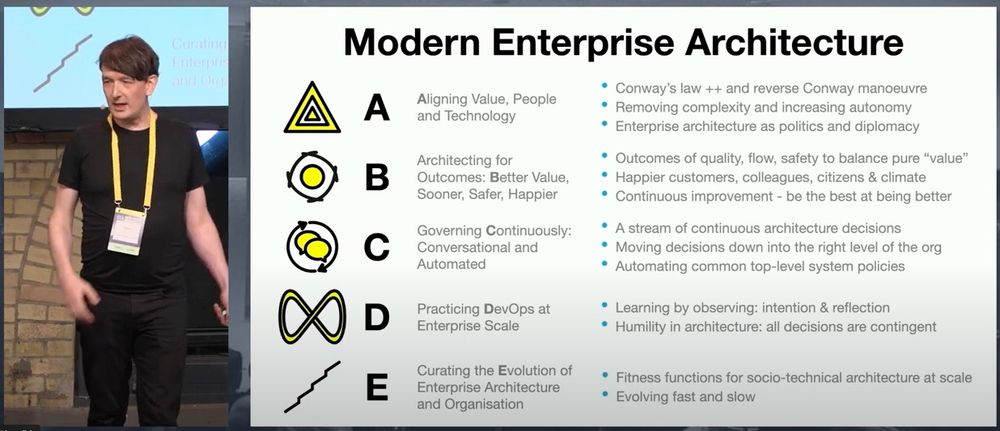
Summary slide here:
28.11.2024 22:59
👍 1
🔁 1
💬 0
📌 0
Let me share my take-aways.
1. He borrows from Martin Fowler (a lot) - I like the idea of a conference talk titled "Martin Fowler talked about this 20 years ago!"
28.11.2024 22:59
👍 0
🔁 1
💬 1
📌 0