
Working on it: weather.uwyo.edu/wsgi/soundin...
06.03.2026 22:03
👍 1
🔁 0
💬 1
📌 0
Working on it: weather.uwyo.edu/wsgi/soundin...

Attached is a special sounding launched from College Station, TX at 2033Z March 6th, 2026 valid at 21Z. Data has been sent to be assimilated, and the TEMP data should hopefully show up on the new University of Wyoming soundings page. @nws.noaa.gov

Wow! Officially the biggest snowstorm in RI history. Providence will make a run at 40 inches

Special sounding launched from College Station, TX at 2028Z February 14th, 2026 valid at ~21Z. This was launched just ahead of the convective line. Warm nose from last sounding has eroded and low-level hodograph is impressive.

Special sounding launched from College Station, TX at 1730Z February 14th, 2026 valid at 18Z. Skies were a bit overcast with some slight clearing occurring since launch. 21Z balloon is planned.

Never thought I would be involved in a paper on the cover of @science.org! It was awesome being involved in this collaborative project.
Detecting supramolecular organic nanoparticles during heat wave | Science www.science.org/eprint/H4ETN...
🚨 🚀 A crude interface I built to expose an archive of College of DuPage GOES imagery since about 15 Apr 2017. The archive is around ~500TB in size over ~2.5 billion JPEG images. Yikes, but here you go.
mesonet.agron.iastate.edu/archive/cods...
Anyways happy for feedback. Not worth the effort?
Yesterday, Suomi-NPP passed over Tropical Cyclone Dudzai and its central eye.
This was very fun to work on, emerging from student class projects a few years ago. How sharp can a cold front get? We were able to point to some answers.
This entire train got blown over this morning northwest of Cheyenne
top 10 TDWR loop from that environment

Attached is a 1949UTC special sounding from College Station, TX. Balloon was launched between the initial round of storms and ahead of the main frontal boundary. There is some convective contamination between ~540mb and 450mb, as we hit an updraft at this point.
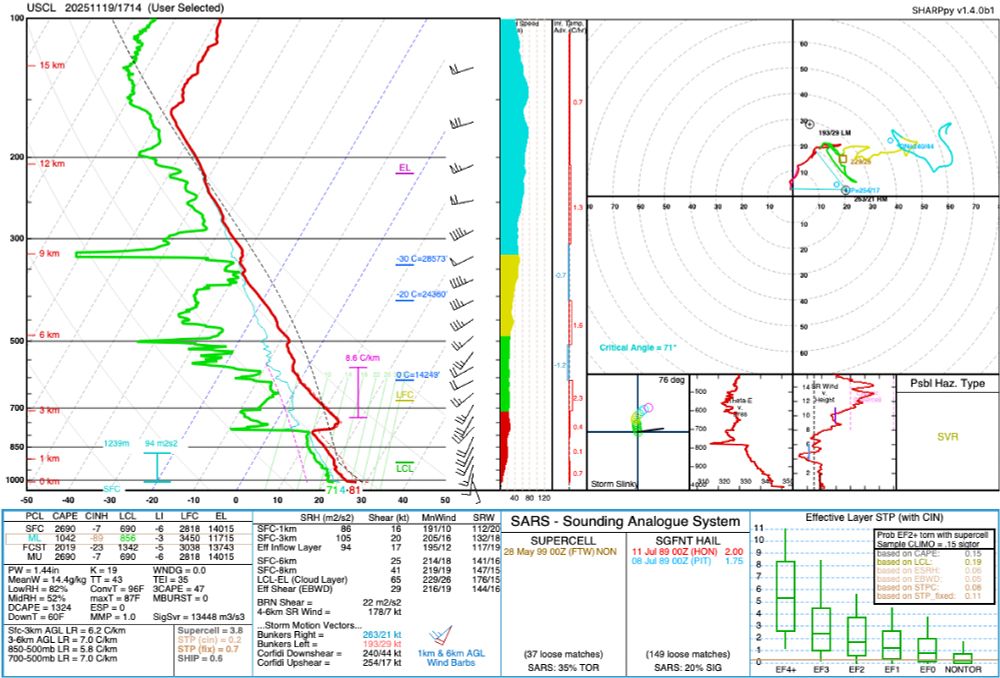
Below is a November 19th, 2025 1714 UTC special sounding launched as part of our ATMO-251 class from Texas A&M's campus. Sharppy image and sharppy file are attached. Mixed layer parcel is also plotted. Launch was done as morning stratus deck was clearing.
Annotating a long 3+ day loop of #Hurricane #Melissa from Kingston, #Jamaica radar.
2️⃣ periods appear where an eyewall replacement cycle, #ERC, looked underway. In both cases, inner eyewall stayed intact & outer bands merged, resulting in a larger eye & strengthening after.
A remarkable evolution 🌀

The Copernicus Sentinel-2 polar-orbiting satellite made an extremely fortuitous pass over Hurricane Melissa right before it made landfall in Jamaica to provide these stunning images of one of the most powerful Atlantic hurricanes in history


I was worried for my crew mates when I saw them circling in the eye for over 20 mins. Looks like the very rough ride was confirmed. Plane had to leave early. They reported svr turb and a "sawtooth" eye. Looks like they moved 600-700ft up & down during this stretch in ~1 min.


This has probably already been posted here, but Melissa has displayed a classic mesovortex pattern that can be modeled in the simplest 2D atmospheric models ("nondivergent barotropic models"). Here's a comparison of this morning's VIS sat and Kossin and Schubert (2001) experiments.

Looking back at the rapid intensification of #Melissa, two things really stand out to me:
1) there were *5* consecutive six-hourly periods of RI
2) an RI period began when the storm was already at Category 4 intensity
The red entries here highlight when an RI period began (30+ kt in 24 hr).
1-minute #GOES19/#GOESEast Visible and Infrared images with plots of GLM Flash Points showed prolific lightning activity within the inner eyewall of Category 5 Hurricane #Melissa as it approaches the SW coast of Jamaica. Low-altitude mesovortices persist within the eye.
A 10am EDT update from the National Hurricane Center now puts Melissa's sustained winds at 185 mph. Full text: www.nhc.noaa.gov/text/refresh...?

This is hands down the most extraordinary dropsonde in Atlantic recon history.

Text summary of wind data from dropsonde released in northeast eyewall of Melissa, showing mean wind of 185 knots in lowest 150 m.
The most recent recon data suggests that Melissa continues to intensify. Central pressure now down to 907 mb and a dropsonde released in the northeast eyewall measured a mean wind in the lower 150m of 185 knots (213 mph). This hurricane is truly in rarefied air as far as Atlantic hurricanes.
Here it is. The last 10 years of hail events across the U.S. using my prototype hail tracking algorithm!
Hoping to build out a more robust climatology of hailstorms like we have for tornadoes.
The EF-5 drought appears to be over wow
kamala.cod.edu/offs/KFGF/25...
“Those who can make you believe absurdities, can make you commit atrocities.” - Voltaire.

Here is a 4-day track summary of Hurricanes #Humberto and #Imelda, showcasing an example of the #Fujiwhara Effect. They approached and interacted with each other, coming within 465 miles, but did not complete an orbit around a common center or merge before moving back away from each other.
[1/4]

Still GeoColor satellite imagery from GOES-19 of cumulus clouds forming circular pattern in the Southeast United States on 2025-09-05.
The center of high pressure in the Southeast United States is revealed by dotted cumulus clouds in a circular pattern.
Areas of high pressure often dominate the broad atmospheric circulation in which clouds flow within. (2/3)
🚨 Recruiting Two PhD/MS Students 🚨
I am looking to bring on at least two GRAs (M.S. or Ph.D. Level) beginning Spring or Fall 2026 to join our CHAOS research group. Research projects will be related to artificial intelligence and machine learning applications for extreme temperatures and rainfall


