Merry Christmas all!
25.12.2025 11:34
👍 1
🔁 0
💬 0
📌 0

@liverpoolas.org
We're Liverpool Astronomical Society, founded in 1881. Our (Latin) motto is "Sic Itur Ad Astra", which means "Thus, The Way To The Stars." Our goal is to advance, promote, inform, inspire and educate on the science of astronomy and associated sciences.
Merry Christmas all!

Bortle 3, but M8 still put on a show! My broadband shot of the Lagoon Nebula came out better than expected. Love this complex mix of glowing magenta gas, the intricate dark dust lanes, and the brilliant sparkle of the NGC 6530 cluster. ✨ #astrophotography #space
Bortle 3 skies, and the view is unreal. broadband shot of M8, the Lagoon Nebula, It's a complex mix of glowing magenta gas, intricate dark dust lanes, and the brilliant sparkle of the open cluster NGC 6530.✨ #astrophotography
@hasungazer.bsky.social
#StormHour #MoonHour
@liverpoolas.org
#space

What a great choice for Astronomer Royal 🙌🔭
#Astrophotography #Astronomy #Space #lookup
@liverpoolas.org
www.bbc.com/news/article...

Telescope: William Optics Z73 Camera: ZWO ASI533MC PRO Filters: Optolong L-eXtreme Exposure: 50 x 180s Gain: 120
Processed data from last night's Eastern Veil Nebula
Telescope: William Optics Z73
Focal Length: 430mm F5.6
Camera: ZWO ASI533MC PRO
Filters: Optolong L-eXtreme
Exposure: 50 x 180s
Gain: 120
#Astrophotography #Astronomy #Space #StormHour #MoonHour #ThePhotoHour #lookup
@liverpoolas.org

Comet lemmon

Comet lemmon
So have finished processing the 1st nights data of #cometlemmon from 1/11/25 this is created from 190 x 15s images stacked and blended.
Thanks for suggestion from @flyinghabu.bsky.social
enjoy ☄️
#Astrophotography #Astronomy #Space #StormHour #MoonHour #ThePhotoHour #lookup
@liverpoolas.org

3 minute narrowband image of the supernova remnant NGC 6960, featuring complex filaments of ionized gas rendered in a vibrant blue-green (Oxygen) and red (Hydrogen) color palette.
Time to make the most of this clear window! Getting ready to capture the breathtaking, vibrant filaments of the Western Veil #Nebula (NGC6960). It's a remnant of a massive star's death, and truly one of the sky's masterpieces.
What's your favorite nebula? 👇
#Astrophotography
@liverpoolas.org
Short video of the live stacking, enjoy ✨
#Astrophotography #Astronomy #Space #StormHour #MoonHour #ThePhotoHour #lookup
@liverpoolas.org

Ah, the Ring Nebula, M57! Just gazing at its ethereal beauty through a telescope sparks the imagination, doesn't it? But let's really dream for a moment, casting aside the current limitations of our technology and knowledge. What could the future hold for our understanding and exploration of this cosmic marvel? Imagine, if you will, a future where we have developed sophisticated, autonomous probes capable of traversing interstellar distances in a reasonable timeframe. Picture one such probe, equipped with sensors far beyond our current capabilities, gently maneuvering through the glowing tendrils of M57. What secrets would it unveil? Could it map the three-dimensional structure of the nebula with unprecedented accuracy, revealing intricate knots and filaments we can only hint at now? Perhaps it could analyze the precise elemental composition at various points, giving us a much clearer picture of the dying star's final contributions to the cosmos. And what about the central white dwarf? Imagine a probe that could safely approach its intense gravity and radiation, perhaps even deploying tiny, resilient sensors onto its surface. What exotic states of matter might we discover under such extreme conditions? Could we learn more about the processes that lead to the formation of these stellar remnants? Beyond robotic exploration, let's really stretch our minds. What if future generations develop technologies that allow for human presence in such environments? Imagine a research outpost orbiting the white dwarf, shielded from its radiation, where scientists could directly observe the nebula's evolution in real-time. Perhaps they could even deploy advanced instruments to manipulate the nebula on a small scale, allowing for controlled experiments to test our astrophysical models. Think even further! Could we one day harness the energy released by such dying stars? It's a long shot, of course, but what if the intense radiation and magnetic fields could be safely channeled for s…
Gazing at the Ring Nebula #M57 tonight! 🌌 This cosmic smoke ring, a dying star's farewell, is a beautiful reminder of the universe's cycle of birth and death, one of my favourite DSO objects.
#Astrophotography #Astronomy #Space #StormHour #MoonHour #ThePhotoHour #lookup
@liverpoolas.org

10 hrs of Drako triplet

5 hrs Drako Triplet
So been able to get 2 full nights now on the Drako Triplet, here's both nights images 5hrs then 10hrs
#Astrophotography #Astronomy #Space #StormHour #MoonHour #ThePhotoHour #lookup
@liverpoolas.org

The Drako triplet
Done a quick stack and process of the Drako Triplet from last night,
1 lenticular in NGC5981
2 elliptical in NGC5982
3 NGC5985 a barred spiral
Will get another night of data tonight.
#Astrophotography #Astronomy #Space #StormHour #MoonHour #ThePhotoHour #lookup
@liverpoolas.org

Such short nights now, only about 2 hours of astronomical darkness currently and getting shorter 😔
Here's my image of the sunflower galaxy from last month with 4 hrs of data.
#Astrophotography #Astronomy #Space #StormHour #MoonHour #ThePhotoHour #lookup
@liverpoolas.org

The Draco triplet
Inspired to go for the Draco triplet as we come to the end of #Galaxy season, so going to get a couple of nights on this interesting collection.
#Astrophotography #Astronomy #Space #StormHour #MoonHour #ThePhotoHour #lookup
@liverpoolas.org

Looking for the next available clear night to run our next #livestream of the Sky at Night magazine's Deep Sky Tour for May. Subscribe and select reminder to see when it will occur:
@liverpoolas.org
#Astrophotography #Astronomy #Space
youtube.com/@paramountob...

A digital terrain model of the (in)famous "Face on Mars" further reveals that it's really a large, eroded hill of a type called "mimetolith". (NASA/JPL-Caltech/University of Arizona)
Sunrise to Sunset on the Martian Mimetolith
This particular mesa acquired a certain notoriety when an image was captured by the Viking 1 orbiter on 25 July 1976. The shadows cast across the feature created a pareidolic perception of a human face.
More: uahirise.org/hipod/ESP_08...
#Mars
Whirlpool vibes in the cosmos! 🌀 Check out this image of M63, the Sunflower Galaxy, located about 27 million light-years away. Its bright yellow core and spiraling arms dotted with young blue stars make it a truly photogenic beauty.
With clear skies, I was able to get over 4hrs on #M63 the 'Sunflower Galaxy'. Located about 27 million light-years away. Its bright yellow core and spiraling arms dotted with young blue stars make it a photogenic beauty.
#Astrophotography #StormHour #MoonHour #ThePhotoHour
@liverpoolas.org
A spell of much warmer weather is on the way next week 📈
As the jet stream becomes more amplified this weekend, a 'blocked' weather pattern will develop across northwest Europe - but how long this lasts for is uncertain
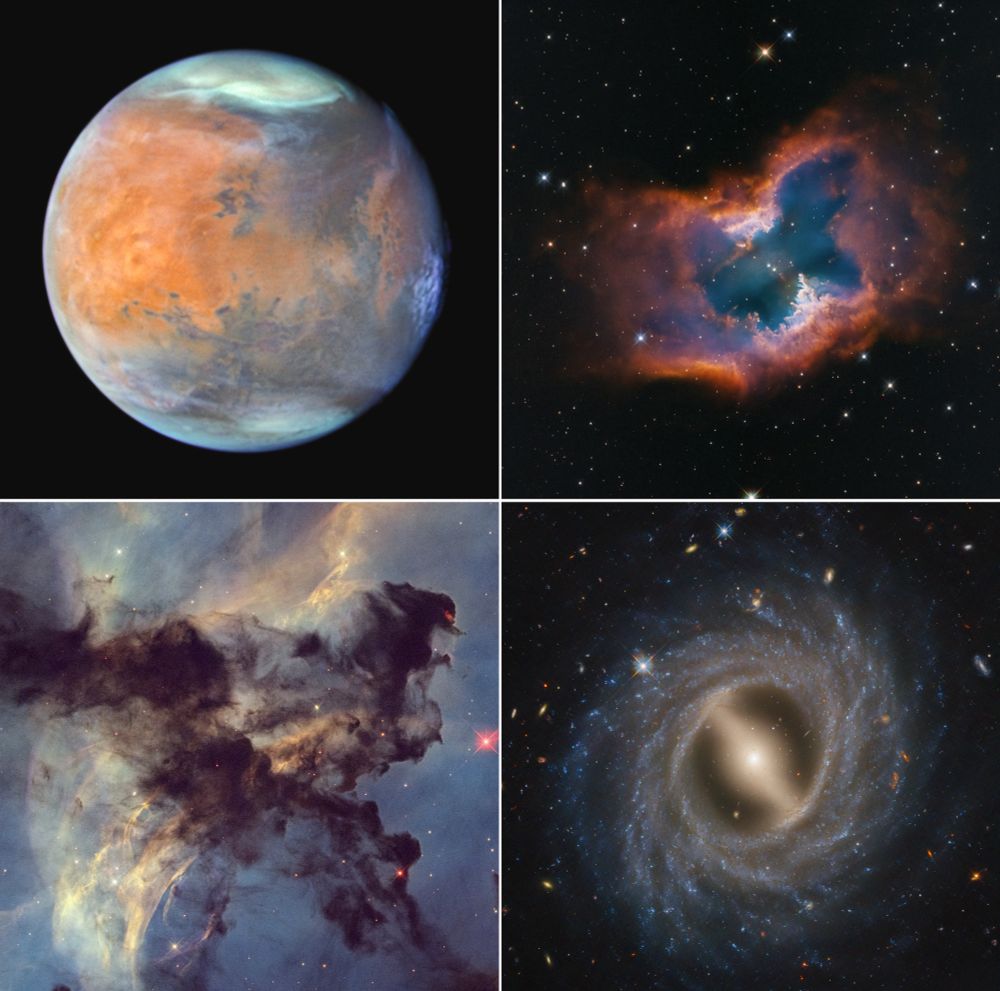
Composite shows four Hubble images in quarters. At top left is a crisp view of Mars in shades of orange, blues, and browns. At top right is planetary nebula NGC 2899, which is shaped like a single macaroni noodle, with its central torus appearing semi-transparent and blue and green, and its top and bottom edges in orange. At bottom left is a tiny portion of the Rosette Nebula. Very dark gray material shaped like a triangle takes up the center. At bottom right is barred spiral galaxy NGC 5335 with a milky yellow center that forms a bar surrounded by multiple blue star-filled spiral arms that wrap up counterclockwise.
i love that we got 4 new hubble images today and we still continue to get more after 35 years 🥹
hubble really is the little telescope that could!!!

Star cluster the Beehive at left of centre. Orange planet Mars above right of centre. Many faint star dots on a dark background.
A bit of a reprocess of last night's Mars and the Beehive pic. 🔭 🧪 🎨 #astrophotography #SciArt #photography #StormHour #ThePhotoHour
A great talk from yesterday which you can still watch in full

The Hubble Space Telescope turns 35 this week.
To celebrate, here's one of its most iconic photographs: the Pillars of Creation.
These pillars are actually star-forming regions of gas and dust, and from top to bottom are more than FIVE LIGHTYEARS tall—farther than the distance to our nearest star.
… meetings that often, different groups of members tend to attend different types of meeting/outreach, or are more noticeable at some. I think too, there's an understandable aspect of women perhaps not feeling comfortable being out in the dark around a lot of men who they may not know.
Ah well no worries :-) I thought it was important to say anyway.
Interestingly, the number of women members wasn't that much lower back then either for us, prob 20% or so (which is what the International Astronomical Union's is now I believe) however we do so many different types of events and …
… reputation, to reconsider. You are welcome with us.
One day I would like to see an equal balance of women vs men in all aspects of life, including science and astronomy.
All the best,
Mark Galvin
Secretary,
Liverpool AS
Nancy Grace Roman, Henrietta Swan Leavitt, Professor Françoise Combes, Dorothea Klumpke, Margaret Walton Mayall and so, so many more, all did (or are still doing) vital work to advance science and astronomy.
We encourage any women reading who have been put off astronomy because of the 'old man' …
… work women have done over the centuries to advance science. People forget that 'computer' used to be a job description - usually a woman - employed to do all the boring calculations that the men were 'far too busy' to do.
Names such as Dame Prof. Jocylene Bell-Burnell, Caroline Herschel, …
You are correct though that astronomy in general is often regarded as something for old men. We hope that we are progressive in refuting this idea and encourage all to enjoy this fascinating & rewarding subject.
Astronomy, space travel, etc. would not be were it is without the enormous amount of …
Hi @soapachu.bsky.social , I can confirm that we do have women members, including 2 currently on our governing committee.
I've just checked our records for the 2024-2025 membership, revealing a total of 24% (42 out of 177).
Best regards,
Mark Galvin
Secretary,
Liverpool Astronomical Society


Adjacent lectures rooms at University of Liverpool; ancient skills and astronomy
I’m currently between Rocks and Hard Space

"Preventing the addition of new debris is no longer sufficient. We must now actively clean up the space environment to halt the onset of a chain reaction that could render heavily utilised regions unusable. Immediate and decisive action is necessary."
Read the ESA Space Environment Report 2025 👇

A colourful flyer, giving the title and link, other text reads "New email discussion group for astronomy/space communicators. Bullet point list: University Outreach; Amateaur Astronomers; Planetarians; Non-Formal Educators; Activity Leaders. Share Resources - Get Tips - Find Information & Training - Tell Stories - Ask Questions - Give Advice - Share Successes.
BIG NEWS for all UK Astonomy/Space outreachers and non-formal communicators. We have a new email list! A friendly supportive space for sharing ideas, resources, successes, and training opportunities (incl. upcoming free online events from ASDC and RAS). Sign up at www.jiscmail.ac.uk/astromailbox

