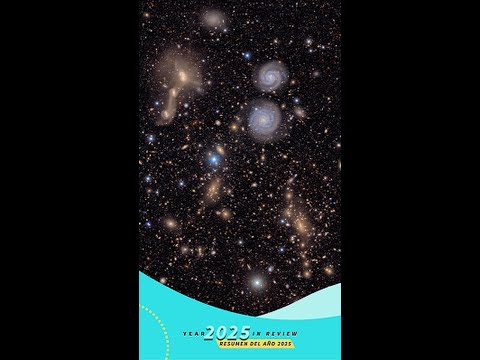
First Look wasn't just pretty images. It was proof that Rubin’s systems were working together to produce the high-quality data the science community has been waiting for! 🔭🧪
Relive #RubinFirstLook: rubinobservatory.org/news/rubin-f...
.
.
.
All 📷,🎥: NSF–DOE Rubin Obs/NOIRLab/SLAC/AURA
#RubinFirstLook revealed stunning detail in the Virgo Cluster and the Trifid & Lagoon Nebulae. 🔭🧪
It also showed Rubin's ability to see changes in the sky: detecting 2,000+ new asteroids and measuring 46 pulsating stars in just 10 total hours of observing!
youtu.be/V_gNvZxdNXQ
L1 lens, 2018 photo by LSST ( Large Synoptic Survey Telescope ) first put into service this year, in June 2025 • CC BY 4.0 via Wikipedia
Spinoza would've loved to see this.
The human-sized L1 lens of the Rubin Observatory camera, or the first lens of the observatory's telescope, at 1.55 m in diameter, the largest lens ever built.
#Astronomy #RubinFirstLook #NightSkyViewer
Some galaxies love to hog the spotlight, but sometimes we see past them! 🔭
In this image from the #RubinFirstLook Cosmic Treasure Chest, a distant galaxy peeks from behind a large foreground galaxy.
This "layered" view helps scientists understand the 3D structure of the Universe 🌌🔭🧪
A cosmic tapestry of glowing tan, blue, and pink gas clouds with dark dust lanes. At center, the Trifid Nebula resembles a flower in space. Its soft, pinkish gas petals are surrounded by blue gas, and streaked with dark, finger-like veins of dust that divide it into three parts. It radiates a gentle, misty glow, diffuse and soft like the warmth of breath on a cold hand.
A churning sea of magenta gas, with bright blue pinpricks sprinkled throughout where new stars are born. Short tendrils of dark dust etch the magenta backdrop like scratches in a smooth surface.
A churning sea of magenta gas sandwiched by a tan backdrop made of countless stars. Bright blue, knotted clumps are sprinkled throughout where new stars are born. A vast yet narrow dust lane sweeps down the left side of the image, like a slash in a tapestry. Additional short features of dark dust cut the magenta gas like scratches in a smooth surface.
Come to the dark side... 😼
We're looking at dark nebulae in the #RubinFirstLook image of the Trifid & Lagoon Nebulae. Dark nebulae are clouds of gas and dust that are so dense they block visible light. This makes them appear black against their colorful, cloudy background. ☁️🔭🧪
With SkySynth, the #RubinFirstLook images are ear-resistable 👂✨
SkySynth transforms the Virgo Cluster into a sparkling symphony of science! 🔭 🧪 Instead of conveying data visually, a sonification like SkySynth translates data into sound.
Listen now: skyviewer.app/skysynth
🚀 Big week for the Rubin Observatory! 🌌 Hundreds joined in Tucson & online to explore new data, celebrate #RubinFirstLook images, and mark key milestones. Next: the decade-long LSST starts later this year! 🔭✨ #Astronomy #SpaceScience #RubinObservatory #LSST #Telescope
We recapped an incredible past year installing final observatory components, premiering #RubinFirstLook images, and beginning the months-long commissioning phase ✨
But we didn't only look back! We also looked forward to the start of the decade-long Legacy Survey of Space and Time later this year 🔭🧪
A glittering tapestry of thousands of galaxies in varying sizes, shapes, and colors. At center is a distinct collection of galaxies, all of a similar yellow color.
A glittering tapestry of thousands of galaxies in varying sizes, shapes, and colors. At center is a distinct collection of galaxies, all of a similar orange color.
A glittering tapestry of thousands of galaxies in varying sizes, shapes, and colors. At center is a distinct collection of galaxies, all of a similar red color.
NSF–DOE Rubin Observatory's view of the Virgo Cluster is full of galaxy clusters: collections of gravitationally-bound galaxies ✨ They can be identified as similarly colored smudges concentrated together.
Here, we can see three different clusters at different distances. #RubinFirstLook 🔭🧪
Ever been to a party so good you couldn’t stop talking about it?
Same here 🥳
#RubinFirstLook was unforgettable, and made even more incredible thanks to 360+ Watch Parties around the world celebrating with us on June 23! 🔭🧪
Enjoy this trip down memory lane with us 🤩
It's #WallpaperWednesday again! Get your #RubinFirstLook background here!
🎧 Prof. Paweł Pietrukowicz opowiedział o Obserwatorium im. Very C. Rubin @vrubinobs.bsky.social w Radiu Kampus:
▶️ radiokampus.fm/podcasty/kam...
▶️ youtu.be/B8z7fwW408Y
🔎 Zdjęcia ➡️ skyviewer.app/explorer
📷 Gromada w Pannie. Źródło: RubinObs/NOIRLab/SLAC/NSF/DOE/AURA
#RubinFirstLook #CaptureTheCosmos
The audience listens in on the 'early science with Rubin LSST in 2025' session at NAM 2025.
The talk on the Vera C. Rubin Observatory.
The final sessions of Day 1 of #NAM2025 are now kicking off.
They include one on the 'early science with Rubin LSST in 2025'. Only last month we got the #RubinFirstLook at the cosmos, which was captured by the revolutionary telescope @vrubinobs.bsky.social.
⤵️
First Images from NSF–DOE Vera C. Rubin Observatory | #RubinFirstLook
NOIRLabAstro
www.youtube.com/live/SpTpoF7...
Primeras Imágenes del Observatorio Vera C. Rubin NSF–DOE | #RubinFirstLook
NOIRLabAstro
www.youtube.com/live/wvwGTE0...
Dense field of blue and yellow stars against a vibrant, glowing backdrop of orange and red nebula clouds.
Dense cluster of bright blue stars shining like beacons against wispy nebula cloud of orange and blue. The background is filled with countless smaller stars.
Image of a globular cluster with a radiant core and a mix of blue and orange stars spread throughout against a yellow-orange background of wispy nebula clouds.
Our favorite kinds of fireworks are the cosmic kind 🌟🎆
Our #RubinFirstLook image of the Trifid and Lagoon Nebulae has plenty of cosmic fireworks to explore! Let the bright, young stars in these clusters add some sparkle to your #FourthOfJuly holiday ✨🔭🧪
📷: NSF–DOE Rubin Obs.
A field of galaxies scattered across the deep black of space. It is filled with galaxies of many shapes, sizes and colors, as well as the multi-colored points of stars. To the lower left is a region filled with the hundreds of golden glittering gems of a distant galaxy cluster. In the foreground, below and left of center, two blue spiral galaxies look like eyes to the left of the entangled mass of a triple merger. A few bright blue points of foreground stars pierce the glittering tapestry.
A field of galaxies scattered across the black of space. It is filled with galaxies of many shapes, sizes and colors, as well as the bright multi-colored points of stars. The image focuses on a collection of interacting galaxies connected by delicate streams of stars. Like spider silk, these stellar bridges link the large elliptical to the few larger galaxies beneath.
A tapestry of glowing tan and pink gas clouds with dark dust lanes. In the lower right, the Trifid Nebula resembles a small flower in space. Its pink gas petals are surrounded by blue gas, and streaked with dark veins of dust. To the upper left, the larger Lagoon Nebula stretches wide like a churning sea of magenta gas, with bright blue, knotted clumps sprinkled throughout
Dense cluster of bright blue stars shining like beacons against wispy nebula cloud of orange and blue. The background is filled with countless smaller stars.
#WallpaperWednesday: #RubinFirstLook edition 🤩
Need a new phone background? Loved the first images from NSF–DOE Rubin Observatory?
We've got you! Save one of these to use, set it, and enjoy the cosmos captured by Rubin every time you use your phone 🌌🔭🧪
My guess is that these two distinct stats got distorted/merged in some minds & then incorrectly shared, in amongst all the excitement about #RubinFirstLook, with the BBC journalist. In the future our #scicomm must be better. Great that BBCR4 More or Less exists though to issue these corrections! 🔭
Star trails are seen over NSF–DOE Vera C. Rubin Observatory in this timelapse image captured during First Look observation activities in April 2025.
Star Trails over Rubin
Credit: RubinObs/NOIRLab/SLAC/NSF/DOE/AURA/P. Horálek (Institute of Physics in Opava)
@vrubinobs.bsky.social @noirlabastro.bsky.social
noirlab.edu/public/image... #RubinFirstLook 🧪 🔭
Any teachers/parents looking for some fun space activities for their class/kids? Check out the @vrubinobs.bsky.social #RubinFirstLook resources. I particularly like the colouring-in book and #SpaceSurveyors game.
👉: rubinobservatory.org/education/fi...
🎮: spacesurveyors.app
🔭🎢👩🔬 #scicomm
NSF–DOE Vera C. Rubin Observatory is seen with its dome open during First Look observation activities in April 2025. Messier 41, the Little Beehive Cluster, can be seen over the telescope in this telelens photo. Image released June 23, 2025.
Rubin with M41 during First Look Observations
Credit: RubinObs/NOIRLab/SLAC/NSF/DOE/AURA/P. Horálek (Institute of Physics in Opava)
noirlab.edu/public/image... @vrubinobs.bsky.social @noirlabastro.bsky.social #RubinFirstLook 🧪🔭
The #RubinFirstLook has us 🤩
"These images mark the beginning of an avalanche of data," said IPAC Manager David Imel.
At IPAC, we've been developing the Science User Interface and Tools for the Rubin LSST Science Platform.
Read about IPAC & @vrubinobs.bsky.social: ipac.caltech.edu/project/rubin
Galaxies zoomed in the Virgo Cluster
Found one of my favorite spots exploring @vrubin.bsk.social Skyview!! The amount of galaxies in this image is incredible! 🌌🔭
#RubinFirstLook #CaptureTheCosmos
➡️ skyviewer.app/explorer?tar...
6/6
Image credit: RubinObs/NOIRLab/SLAC/NSF/DOE/AURA
NOIRLab Press release➡️ noirlab.edu/public/news/...
More➡️ rubinobservatory.org/news/rubin-f...
🔭 🧪 #RubinFirstLook #CaptureTheCosmos
The image shows a small corner of total view of the Virgo Cluster, 55 Mly away. Visible are two notable spiral galaxies (NGC 4411b, left and NCG 4411a, right), a group of three merging galaxies (RSCG 55), galaxy groups both near and distant, stars within our own galaxy, and much more.
🧵
The first images from the NSF–DOE Vera C. Rubin Observatory are here, and they are breathtaking!
This spectacular image shows only a small section of total view of the Virgo Cluster, 55 Mly away.
ONLY A SMALL SECTION!
➡️ noirlab.edu/public/image...
🔭 🧪 #RubinFirstLook #CaptureTheCosmos
Glemte å legge ut linken med thumbnail, så her er den😄🤓 www.space.com/astronomy/ve... #astronomy #capturethecosmos #rubinfirstlook #astronomi #astrofoto #astrophoto #astrophotography #vitenskap #science #research #astrofotografi
Første bilde fra verdens største kamera, #LSST Camera ved NSF-DOE Vera C. Rubin-observatoriet i Chile, avslører tusenvis av astroider, og millioner av galakser☺️☄️🌌 Gjennom ti år skal LSST ta bilde av rundt 20 mrd galakser!🪐🌟 www.space.com/astronomy/ve... #astronomy #capturethecosmos #rubinfirstlook
Whew, what a day!
Today we revealed the preview of NSF–DOE Rubin Observatory's epic cosmic movie🎬 #RubinFirstLook
From wide-field and deep views of the Universe, to the dynamic and changing sky, Rubin is already bringing the night sky to life! 🔭🧪
rubinobservatory.org/news/first-i...
First Images from NSF–DOE Vera C. Rubin Observatory | #RubinFirstLook
SLAC National Accelerator Laboratory
youtu.be/daKlQha7aZM?...
I just had a look around ... and ....
look at them twinsies.
LOOK AT THEM 😍
#RubinFirstLook #CaptureTheCosmos 🔭🧪